EPDM Rubber: Properties, Uses and Grades Explained
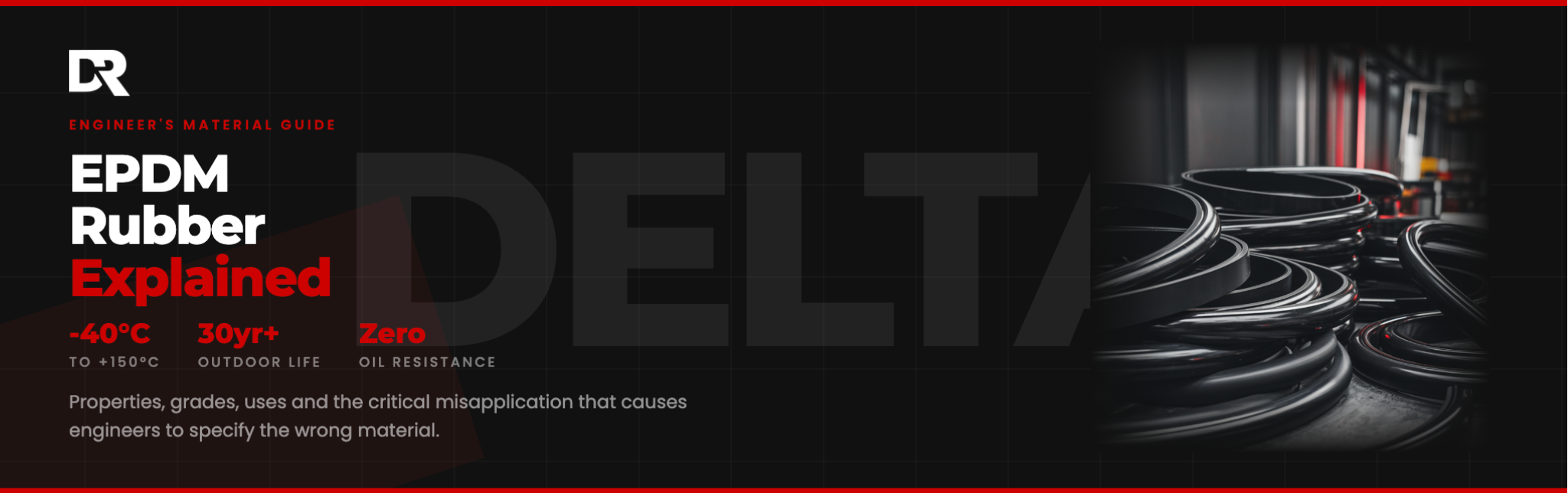
EPDM rubber is a synthetic elastomer made from ethylene, propylene, and a diene monomer — most commonly ethylidene norbornene (ENB). The saturated polymer backbone produced by the ethylene-propylene chemistry gives EPDM its defining characteristic: outstanding resistance to ozone, UV radiation, weathering, steam, and hot water. It is the most widely used elastomer for outdoor sealing applications, building and glazing gaskets, automotive door and window seals, and steam-related services.
What EPDM cannot do is equally important: it has essentially zero resistance to petroleum oils, fuels, and mineral hydraulic fluids. This is the single most common misapplication in rubber specification — and it causes premature seal failure every time. If your media is oil or fuel, EPDM is not the material.
What Does EPDM Stand For?
EPDM stands for Ethylene Propylene Diene Monomer — the three chemical building blocks of the polymer. Under ISO 1629 and ASTM D1418, it is formally designated as EPDM. The diene component (typically ENB, or alternatively DCPD or HD) introduces unsaturation into the side chains of the polymer, which provides the crosslink sites needed for vulcanisation while leaving the main polymer backbone fully saturated.
This saturated backbone is the structural reason for EPDM’s exceptional weathering resistance. Ozone attacks the double bonds in an elastomer’s main chain — a process that causes surface cracking and progressive degradation. Because EPDM has no double bonds in its backbone, ozone cannot attack it in the same way. The result is an elastomer that outperforms virtually every other common rubber in outdoor and atmospheric exposure.
EPDM Rubber Properties
| Property | Value / Rating |
|---|---|
| Temperature range (continuous) | -40°C to +120°C |
| Temperature range (intermittent peaks) | Up to +150°C (specialist grades) |
| Low-temperature flexibility | Excellent — remains flexible to -50°C in low-temp grades |
| Ozone resistance | Excellent — best of all common elastomers |
| UV and weathering resistance | Excellent |
| Steam resistance | Excellent — suitable for steam to 200°C with appropriate grades |
| Hot water resistance | Excellent |
| Petroleum oil resistance | None — avoid entirely |
| Mineral hydraulic fluid resistance | None — avoid |
| Petrol and diesel resistance | None — avoid |
| Dilute acid and alkali resistance | Good |
| Ketone resistance (acetone, MEK) | Good |
| Electrical insulation properties | Good |
| Shore A hardness range | 40–80 |
| Most common industrial grade | 60–70 Shore A |
What Is EPDM Rubber Used For?
EPDM’s combination of weather resistance, temperature range, and steam compatibility makes it the standard material across a broad range of industries and applications.
Building and Construction
EPDM is the most widely specified rubber in the construction industry. Its applications include:
- Curtain wall and glazing gaskets — sealing glass panels into aluminium frames on commercial buildings, where long-term UV and weather exposure is the primary design requirement
- Door and window weatherstrip seals — both residential and commercial
- Roofing membranes — EPDM sheet is used extensively as a flat roofing membrane, valued for its 40+ year service life in exposed conditions
- Expansion joint seals — in concrete structures subject to thermal movement
- Waterproof sealing tape and extruded profiles for façade systems
Delta’s construction rubber products include EPDM extrusions, sheet, and cut strips for the full range of building sealing applications.
Automotive
EPDM is the dominant elastomer for automotive door seals, window run channels, boot lid seals, and bonnet seals — applications where sustained outdoor exposure, UV resistance, and low-temperature flexibility are critical. Modern vehicles typically contain 5–10 kg of EPDM per car in sealing profiles alone.
Steam and Hot Water Systems
Unlike most elastomers, EPDM handles steam reliably. It is specified for:
- Steam hose liners and jacketed hose
- Steam trap and valve seals
- Hot water plumbing gaskets and seals
- District heating pipe seals
WRAS-approved EPDM (tested to BS 6920) is the standard specification for potable water contact — pipework fittings, valve seals, and water meter gaskets. Where WRAS approval is required, always confirm the specific grade carries a valid approval.
Industrial Sealing and Gasketing
For rubber sheet cut gaskets and custom gaskets, EPDM is the standard choice for:
- Water, steam, and condensate pipework flanges
- Chemical process flanges handling dilute acids, alkalis, and polar solvents
- Outdoor equipment enclosures and junction boxes
- HVAC ductwork and air handling unit gaskets
Electrical
EPDM’s good dielectric properties make it suitable for cable insulation, particularly in applications requiring flexibility at low temperatures and resistance to moisture ingress.

EPDM Grades: Which One Do You Need?
Not all EPDM compounds are equivalent. The grade selection matters for demanding applications:
| Grade | Key Feature | Typical Application |
|---|---|---|
| Standard black (carbon black filled) | General purpose, good mechanical properties | Gaskets, sheet, general sealing |
| Peroxide cured | Better heat resistance, lower compression set | High-temp steam seals, demanding gasketing |
| WRAS approved (BS 6920) | Tested for potable water contact | Water fittings, plumbing seals, valve seats |
| Food grade (FDA) | Compliant with FDA 21 CFR 177.2600 | Food processing equipment seals |
| Flame retardant (EN 45545) | Reduced flame spread and smoke toxicity | Railway vehicles, public transport |
| Low-temperature grade | Flexibility maintained to -50°C | Outdoor equipment in cold climates |
| Sponge / cellular EPDM | Compressible closed-cell or open-cell foam | Low-load weatherstrip, acoustic sealing |
For standard industrial gasketing and sealing at 60–70 Shore A, black carbon-filled EPDM is the appropriate starting specification. Move to peroxide-cured grades for continuous service above 120°C or where compression set resistance is critical over long service intervals.
EPDM vs Neoprene: Which Should You Choose?
Both EPDM and neoprene are general-purpose elastomers with good weathering resistance, but they have different strengths. Choosing between them depends on the specific demands of the application:
| Property | EPDM | Neoprene (CR) |
|---|---|---|
| Ozone resistance | Excellent | Good |
| UV and weathering resistance | Excellent | Good |
| Steam resistance | Excellent | Poor |
| Hot water resistance | Excellent | Moderate |
| Petroleum oil resistance | None | Moderate |
| Flame resistance | Poor (standard grades) | Better |
| Temperature range | -40°C to +150°C | -40°C to +120°C |
| Low-temperature flexibility | Excellent | Good |
| Cost | Low–Medium | Medium |
| WRAS / food grade availability | Yes | Limited |
Choose EPDM when: the primary concerns are weathering, UV, steam, or hot water resistance, and the application is free from petroleum oil or fuel contact.
Choose neoprene when: moderate oil resistance is needed alongside weather resistance, or where flame retardancy is a requirement without upgrading to a specialist EPDM grade.
In practice, EPDM has displaced neoprene in most pure weather-sealing applications because it offers better ozone and UV performance at a lower cost. Neoprene remains the preferred choice where oil contact cannot be fully excluded — such as seals in environments where hydraulic fluid spillage is possible but not the primary media.
Can EPDM Be Used With Oil?
No. This is the most critical misapplication risk with EPDM, and it is worth stating plainly: EPDM has no resistance to petroleum oils, mineral hydraulic fluids, petrol, or diesel. Contact with these media causes rapid and severe swelling — the elastomer absorbs the fluid, loses mechanical integrity, and fails.
This failure mode catches engineers who specify EPDM correctly for water or steam service but then find their system is also exposed to incidental oil contamination — a common scenario in plant maintenance environments, engine bays, or anywhere hydraulic equipment is nearby. If there is any possibility of oil or fuel contact, EPDM must not be used. Specify nitrile for standard oil service, or Viton for high-temperature or aggressive chemical conditions.
The reverse is equally important: never use nitrile in steam or hot water service where EPDM would be the correct choice. These two materials cover opposite ends of the chemical resistance spectrum.
Is EPDM Good for Outdoor Use?
Yes — EPDM is the best performing common elastomer for outdoor applications. Its ozone resistance is unmatched among standard rubber compounds, and its UV stability means it does not surface-crack or degrade under sustained sunlight exposure in the way that natural rubber, nitrile, or SBR compounds do.
For outdoor sealing applications — building façades, roofing, external enclosure gaskets, infrastructure seals — EPDM is the default specification. Service lives of 20–30 years in outdoor exposure are routinely achieved with correctly specified and installed EPDM grades.
The one limitation for outdoor sealing is flame resistance: standard EPDM grades do not offer significant flame retardancy. For applications requiring compliance with fire spread regulations (EN 45545 for rail, BS 476 for construction), specify a flame-retardant EPDM grade.
Frequently Asked Questions
What is EPDM rubber used for?
EPDM is used primarily for outdoor sealing, weatherproofing, and steam or hot water applications. The largest single use is automotive door and window seals. In construction, EPDM is specified for glazing gaskets, weatherstrip profiles, and flat roofing membranes. Industrially, it is used for steam hose, hot water system seals, WRAS-approved water fittings gaskets, and chemical process sealing for non-oil media. It is also used in cable insulation and HVAC gaskets.
Is EPDM rubber good for outdoor use?
Yes — EPDM offers the best outdoor weathering performance of any common elastomer. Its ozone and UV resistance is excellent, and correctly specified EPDM seals and membranes achieve service lives of 20–30 years in exposed outdoor conditions. It is the standard specification for building facade gaskets, roofing membranes, and external weatherstrip seals.
Can EPDM rubber be used with oil?
No. EPDM has essentially no resistance to petroleum oils, mineral hydraulic fluids, petrol, or diesel. Exposure causes rapid swelling and mechanical failure. This is the most common misapplication of EPDM — particularly in mixed-media environments where water or steam is the primary fluid but oil contamination can occur. For oil and fuel service, specify nitrile (NBR) or Viton (FKM) instead.
What is the temperature range of EPDM rubber?
Standard EPDM grades operate continuously from -40°C to +120°C, with intermittent peaks to +150°C in peroxide-cured specialist grades. Low-temperature grades maintain flexibility to -50°C. EPDM is one of the few elastomers suitable for saturated steam service, performing reliably at steam temperatures up to 200°C in appropriate grades.
What is the difference between EPDM and neoprene?
Both are general-purpose synthetic elastomers with good weathering resistance, but EPDM offers superior ozone and UV resistance, better steam and hot water performance, and a wider temperature range. Neoprene provides moderate oil resistance that EPDM cannot match. For most weather-sealing applications, EPDM is the preferred and lower-cost choice. Neoprene is retained where incidental oil contact must be accommodated alongside weather resistance.
Does EPDM require WRAS approval for water applications?
Yes — for potable water contact in the UK, the rubber compound must be tested and approved under BS 6920 (WRAS approval). Standard EPDM grades are not automatically WRAS approved — approval is compound-specific and requires testing. Always confirm that the specific EPDM product carries a current WRAS approval certificate before using it in potable water systems.
EPDM’s combination of weather resistance, steam compatibility, and long outdoor service life makes it the correct choice for the majority of non-oil sealing applications. Its limitation — zero oil and fuel resistance — is a hard boundary, not a guideline. Specify within it and EPDM is one of the most reliable and cost-effective elastomers available. Misapply it in an oil environment and failure is certain.
Browse Delta Rubber’s full EPDM rubber range — available in sheet, extrusions, gaskets, and cut strip — or explore the rubber extrusions and seals range for EPDM profiles cut to your specification.