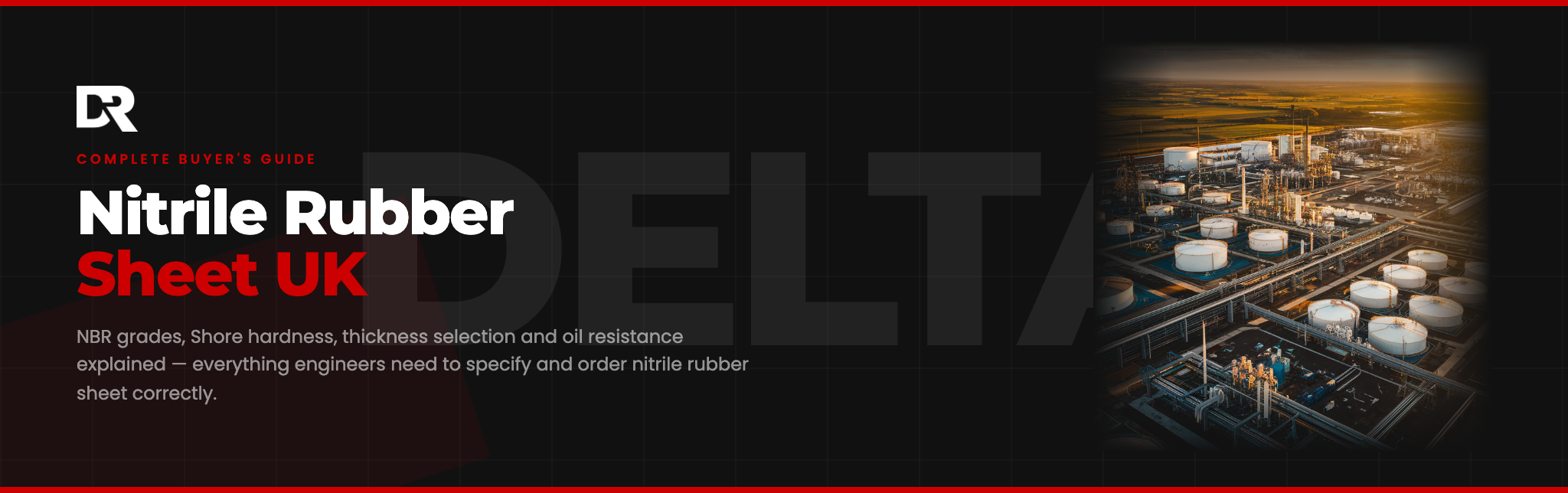
Nitrile Rubber Sheet UK: The Complete Buyer’s Guide for Engineers and Maintenance Teams
Nitrile rubber sheet (NBR — nitrile butadiene rubber) is the engineering standard for applications involving oil, fuel, and hydrocarbon contact. It outperforms neoprene and EPDM in oil-resistance by a significant margin, operates across a temperature range of -30°C to +120°C, and is available in UK stock across a wide range of thicknesses and grades. If you need to seal, line, or protect a surface in contact with petroleum oil, mineral oil, hydraulic fluid, or diesel, nitrile rubber sheet is almost certainly your material.
This guide covers everything you need to specify and order correctly: what nitrile rubber actually is chemically, which grade and hardness to select, how to choose the right thickness for your application, and how to order cut-to-size from a UK supplier.
What Is Nitrile Rubber? (NBR Explained)
Chemical composition and what makes it oil resistant
Nitrile butadiene rubber is a synthetic elastomer produced by co-polymerising butadiene and acrylonitrile (ACN). The ratio of ACN in the final compound is the defining variable in nitrile rubber performance.
Commercial nitrile sheet typically contains 28–34% ACN. Higher ACN content produces greater resistance to oils and fuels but reduces flexibility at low temperatures. Lower ACN content improves cold-temperature flexibility but sacrifices some oil resistance. For most UK industrial applications — gaskets, seals, liners, drip trays — standard commercial-grade nitrile at 33% ACN is the appropriate specification.
The oil resistance of nitrile derives from its polarity. Acrylonitrile groups in the polymer chain resist the non-polar molecules in petroleum hydrocarbons, preventing the swelling and softening that oils cause in non-polar rubbers like EPDM and natural rubber.
Shore hardness and what it means for your application
Nitrile rubber sheet is available in Shore A hardness ratings of 50A, 60A, and 70A. Shore A measures resistance to indentation by a standardised probe — the higher the number, the firmer the material.
- 50 Shore A: Softer, more compliant. Better sealing under lower bolt loads; conforms well to irregular surfaces.
- 60 Shore A: General purpose — the most widely stocked grade, suitable for the majority of industrial applications.
- 70 Shore A: Firmer. Better for mechanical wear applications, cut resistance, and where dimensional stability under load is needed.
Nitrile vs neoprene vs EPDM — choosing the right rubber
| Property | Nitrile (NBR) | Neoprene | EPDM |
|---|---|---|---|
| Oil/fuel resistance | Excellent | Moderate | Poor — avoid |
| Water/steam resistance | Moderate | Good | Excellent |
| Weather/ozone resistance | Poor | Good | Excellent |
| Temperature range | -30°C to +120°C | -40°C to +120°C | -40°C to +120°C |
| General purpose versatility | Good | Very good | Good (water apps) |
The decision rule is straightforward: if the application involves petroleum products, specify nitrile. If it involves water, steam, or outdoor exposure, specify EPDM. Neoprene sits in between and is the practical choice when conditions are mixed.
Key Properties of Nitrile Rubber Sheet
Oil and fuel resistance
Nitrile rubber sheet resists petroleum-based oils, mineral oils, vegetable oils, hydraulic fluids, petrol, diesel, and most fuels. This resistance is stable across the operating temperature range and through repeated exposure cycles — nitrile gaskets and seals in oil-handling machinery routinely last years without degradation under normal operating conditions.
Under ASTM D2000 — the standard classification system for rubber materials — nitrile compounds are classified in the BF, BG, BK, and CH groups, reflecting their oil resistance ratings. Most commercial nitrile sheet suitable for gasket and seal applications falls in the BG or BK classification.
Temperature range
Continuous service: -30°C to +120°C. Short-term peak: +140°C.
Below -30°C, standard nitrile loses flexibility and may crack under mechanical stress. For low-temperature applications, specify a low-temperature nitrile compound (higher butadiene ratio, lower ACN). Above 120°C continuous, nitrile will begin to harden and lose sealing performance — specify Viton (FKM) for sustained high-temperature oil contact above this threshold.
Chemical resistance (what nitrile handles and what it doesn’t)
Resistant to: petroleum oils, mineral oils, vegetable oils, hydraulic fluids, petrol, diesel, LPG, aliphatic hydrocarbons, dilute acids and alkalis.
Not resistant to: ozone, UV, strong oxidising acids, ketones (acetone, MEK), esters, chlorinated solvents, aromatic hydrocarbons (toluene, benzene). Nitrile should not be used in outdoor applications where sustained UV and ozone exposure will cause surface cracking.
Abrasion and wear resistance
Nitrile offers good abrasion resistance — significantly better than silicone, broadly comparable to neoprene. This makes it practical for applications involving mechanical contact, including conveyor scrapers, sliding seals, and protective liners in machinery handling abrasive materials.
Limitations — where nitrile is NOT the right choice
The most critical misapplication risk with nitrile is outdoor or weather-exposed use. Nitrile has poor ozone and UV resistance. A nitrile gasket or seal exposed to outdoor conditions will surface-crack within months even if the sealed medium is compatible. For outdoor, weathering-exposed, or automotive underbody applications, use EPDM or Neoprene.
The second misapplication risk is high-temperature service above 120°C. Buyers who substitute nitrile for Viton to reduce cost in high-temperature applications will experience premature gasket failure. Viton’s material cost is justified where temperatures exceed 120°C continuously.
Nitrile Rubber Sheet Grades and Specifications
Commercial vs. premium grade — what’s the difference?
Commercial grade nitrile is produced to standard dimensional tolerances with typical material properties (hardness, tensile strength, elongation) within broad acceptable ranges. It is appropriate for the vast majority of industrial gasket, seal, and liner applications where specific documented compliance is not required.
Premium grade nitrile is produced to tighter tolerances with documented material test certificates confirming hardness, tensile strength, and oil swell resistance. Required when the application demands documented compliance — in food processing (non-black compounds, FDA-approved grades), pharmaceutical manufacturing, or where a material data sheet must accompany the part for traceability.
Shore A hardness options
- 50A: Soft, compliant. Low bolt-load flanges, irregular seating surfaces.
- 60A: Standard. The default specification — suitable for most industrial gasket and seal applications.
- 70A: Firm. Mechanical wear applications, cut-resistance, dimensional stability under load.
Available thicknesses
| Thickness | Typical Applications |
|---|---|
| 1.5mm | Thin precision gaskets, lightweight flanges, instrument seals |
| 3mm | Standard industrial gasket blanks — the most common specification |
| 4.5mm | Where additional compliance or a thicker seal is needed |
| 6mm | Heavy-duty gaskets, rough flange faces, high-pressure sealing |
| 8mm | Protective liners, drip tray bases, machinery base pads |
| 10mm–12mm | Mechanical cushioning, vibration damping, heavy plant applications |
Roll widths and standard cut-to-length options
Standard nitrile rubber sheet rolls are typically 1.0m or 1.4m wide, supplied in 10m roll lengths or cut to the length required. Delta’s cut-to-size service allows ordering by the linear metre from a minimum of 0.5m — practical for maintenance engineers who need a specific amount rather than a full roll.
Common Applications for Nitrile Rubber Sheet
Gaskets and seals in oil-handling machinery
Nitrile is the default gasket material for oil sumps, gearboxes, hydraulic manifolds, pump housings, and any flanged joint in contact with petroleum products. Where a standard gasket is not available — older machinery, non-standard flanges, imported equipment — nitrile sheet is cut or punched to the required profile. The custom gasket builder at Gaskets Direct allows instant online ordering of CNC-cut nitrile gaskets to any profile.
Fleet workshop and automotive use
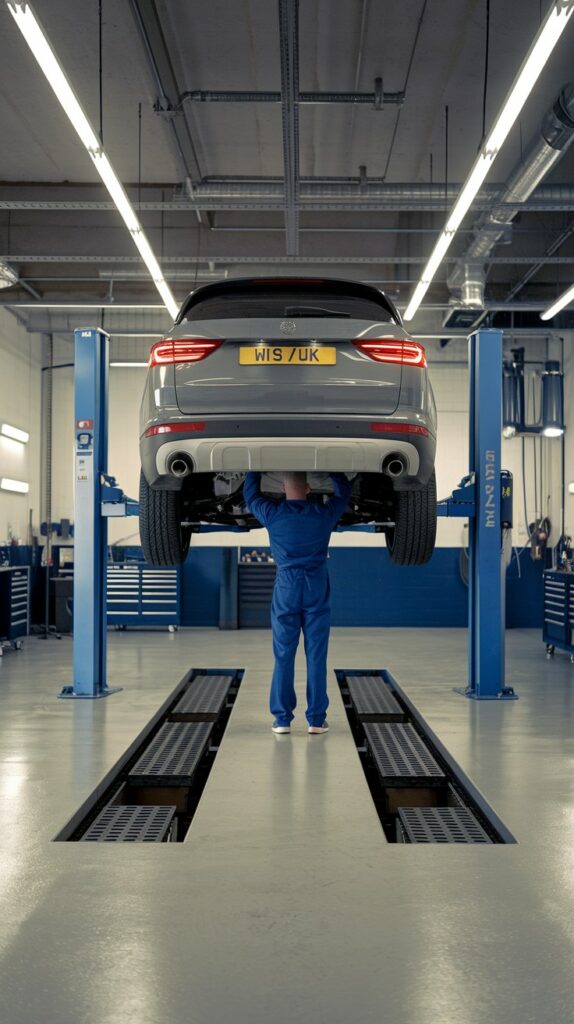
Automotive workshops maintain stocks of nitrile sheet in 3mm and 6mm thickness for cutting valve cover gaskets, sump pan gaskets, and oil gallery blanking plates for classic and vintage vehicles where OEM parts are unavailable. For motorsport applications where fuel system integrity is critical, nitrile is the standard sealing material. Nitrile rubber O-rings and seals are also available from Delta for hydraulic and fuel system replacement work.
Drip trays and spill protection liners
Nitrile sheet is used to line drip trays under oil-using machinery, providing a chemically compatible barrier between spilled oil and the tray substrate. For steel or GRP trays, 3–6mm nitrile sheet bonded or loose-laid provides years of service without oil-related degradation. EPDM sheet, which is cheaper, must never be substituted here — it has no petroleum resistance and will absorb oil and swell.
Punch-cut and CNC-cut gasket blanks
Manufacturing engineers and MRO buyers purchasing nitrile sheet in roll form often cut their own gaskets in-house using punch sets or CNC routers. Delta supplies rubber sheet in roll form suitable for this use — consult the thickness guide above to select the correct starting stock.
Pump and valve packing
Nitrile strip and sheet is used as static and semi-static packing material in pumps and valves handling oils and non-aggressive chemicals. For dynamic sealing in rotating equipment, moulded or extruded nitrile profiles are more appropriate than flat sheet.
How to Specify and Order Nitrile Rubber Sheet in the UK
Choosing the right thickness for your application
The most common specification error is selecting a thickness that is either too thin to conform to the mating surface, or thick enough to require excessive bolt load to achieve adequate compression. The following guidance applies to most bolted flange applications:
- Standard industrial gaskets: 3mm is appropriate for the majority of applications with machined or smooth flange faces.
- Older or rough-faced flanges: 4.5–6mm provides the additional compliance needed to seal surface irregularities.
- Lightweight or low-pressure joints: 1.5mm reduces the bolt load required and is appropriate where the flange is not designed for heavy clamping force.
- Protective liners and drip trays: 4.5–6mm provides the durability and puncture resistance needed for floor-contact applications.
Ordering by the metre vs. cut-to-size
By the metre: Order a length from a standard roll width (1.0m or 1.4m wide). You cut to size on-site. Most cost-effective for maintenance teams who need a stock of material for regular gasket cutting.
Cut-to-size: Specify the exact dimensions you need. Delta cuts the sheet before dispatch. Reduces workshop waste and eliminates the need for in-house cutting equipment for one-off or infrequent purchases.
Full roll: 10m rolls are cost-effective for production or high-volume maintenance requirements. Standard stock item in most grades and thicknesses.
What to check before you buy — a specification checklist
Before ordering, confirm:
– [ ] Application involves oil/fuel contact (if not, reconsider EPDM or neoprene)
– [ ] Operating temperature is within -30°C to +120°C range
– [ ] No sustained outdoor/UV exposure
– [ ] Correct Shore A hardness for the compression requirement
– [ ] Correct thickness for the mating surface condition and bolt load
– [ ] Material grade matches any compliance requirements (food-contact, documented test certificates)
Lead times and UK delivery
Standard nitrile rubber sheet in commercial grades is a stock item at Delta Rubber — typically available for next-day UK mainland delivery. Cut-to-size orders are dispatched same day or next working day depending on order volume. Non-standard grades and very thick sections may require 3–5 working days.
For online ordering, visit shop.deltarubber.co.uk or request a quote for bespoke cut-to-size requirements via deltarubber.co.uk/nitrile.
Frequently Asked Questions
What is nitrile rubber sheet used for?
Nitrile rubber sheet (NBR) is used primarily for applications requiring resistance to petroleum oils, mineral oils, hydraulic fluids, and fuels. Common applications include machine gaskets, automotive seals, drip tray liners, pump packing, and protective liners in oil-handling industrial equipment. It is the standard material for oil-contact sealing in UK engineering and maintenance.
Is nitrile rubber oil resistant?
Yes. Nitrile rubber offers excellent resistance to petroleum-based oils, mineral oils, vegetable oils, and fuels including petrol and diesel. Its oil resistance derives from the acrylonitrile (ACN) content in the polymer chain — most commercial nitrile sheet contains 28–34% ACN, which provides reliable resistance across the material’s operating temperature range of -30°C to +120°C.
What is the difference between nitrile and neoprene rubber sheet?
Nitrile rubber offers superior resistance to petroleum oils, mineral oils, and fuels. Neoprene (polychloroprene) offers better resistance to weathering, ozone, and UV exposure, and performs at a wider low-temperature range. For any application involving oil or fuel contact, specify nitrile. For outdoor, UV-exposed, or weather-resistant applications, specify neoprene or EPDM.
What temperature can nitrile rubber sheet withstand?
Nitrile rubber sheet is rated for continuous use from -30°C to +120°C, with short-term peak tolerance to +140°C. For applications requiring sustained temperatures above 120°C in contact with oils or chemicals, Viton (FKM) rubber is the recommended alternative.
Can nitrile rubber sheet be used outdoors?
No — not for sustained outdoor use. Nitrile has poor resistance to ozone and UV radiation. Extended outdoor exposure will cause surface cracking even if the material is not in contact with an incompatible fluid. For outdoor or weather-exposed sealing applications, specify EPDM or neoprene rubber sheet instead.
What Shore hardness nitrile rubber should I choose?
For standard industrial gaskets and seals, 60 Shore A is the default — it provides the right balance of compliance and mechanical durability. Use 50 Shore A where lower bolt loads or irregular seating surfaces require greater conformance. Use 70 Shore A for applications involving mechanical wear, abrasion, or where dimensional stability under sustained compression is critical.
Nitrile rubber sheet is a precision engineering material, and choosing the right grade, hardness, and thickness matters. Delta Rubber stocks commercial and premium grades across the full thickness range, available cut-to-size or by the metre with fast UK delivery. For gaskets cut from nitrile sheet, Gaskets Direct provides instant online ordering with no tooling charge and no minimum quantity. View the full nitrile rubber range or browse rubber sheet options at Delta Rubber.