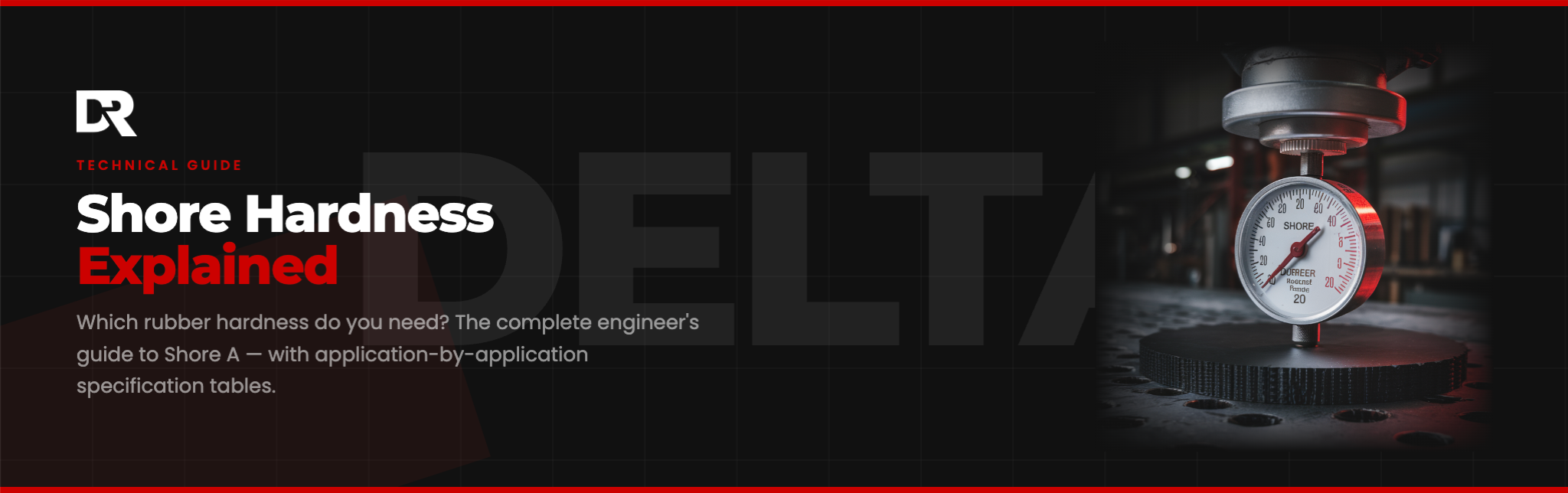
Shore Hardness Explained: Which Rubber Hardness Do You Need?
Shore hardness is a standardised measure of a rubber’s resistance to permanent indentation — expressed as a number from 0 to 100 on either the Shore A or Shore D scale. The higher the number, the harder the material. For rubber and elastomers, Shore A is the relevant scale: a soft silicone sponge might measure 20 Shore A, a standard nitrile gasket 70 Shore A, and a hard engineering rubber compound 90 Shore A. Understanding where your application sits on that scale is the difference between a seal that holds and one that fails within weeks.
Every rubber product Delta Rubber supplies — sheet, extrusions, gaskets, O-rings, matting — is specified by Shore hardness. If you are sourcing rubber for a sealing, vibration, or wear application and you are unsure which hardness to specify, this guide gives you the decision logic to get it right first time.
What Is Shore Hardness?
Shore hardness quantifies how much a standardised indenter tip penetrates a rubber surface under a defined load, measured by a durometer instrument. The test is defined under ISO 7619-1 and ASTM D2240. A spring-loaded probe is pressed against the material surface; the depth of penetration after a fixed dwell time (typically 15 seconds) is converted to a hardness value on a 0–100 scale.
A reading of 0 indicates the indenter sank fully into the material — no measurable resistance. A reading of 100 indicates zero penetration — the material is effectively incompressible under the test conditions. In practice, vulcanised rubbers for industrial use fall between 40 and 90 Shore A.
The Shore hardness of a rubber compound is controlled during manufacture through the polymer type, filler loading (carbon black, silica), and the degree of vulcanisation (crosslink density). This means that for most base rubbers — nitrile, EPDM, neoprene, silicone — multiple hardness grades are available to order.
Shore A vs Shore D: What Is the Difference?
The two scales use different indenter geometries and spring loads, making them suited to different material stiffness ranges:
| Scale | Indenter Type | Material Range | Typical Applications |
|---|---|---|---|
| Shore A | Truncated cone (35° angle) | Soft to medium elastomers | Rubber sheet, gaskets, O-rings, seals, hose, matting |
| Shore D | Sharp cone (30° angle) | Hard rubber, semi-rigid plastics | Hard rubber rollers, polyurethane, ebonite, rigid compounds |
For rubber engineering applications — gaskets, seals, extrusions, vibration mounts, matting — Shore A is the specification you will encounter. Shore D becomes relevant only when the material is so hard it falls above ~95 Shore A, at which point Shore A values compress and lose resolution.
Conversion between the two scales is approximate and material-dependent. As a rough guide, Shore A 95 is roughly equivalent to Shore D 40, but this relationship is not linear and should not be relied upon for precise specification.
How Is Shore Hardness Measured?
Under ISO 7619-1:2010 (and the equivalent ASTM D2240), the test requires:
- A minimum specimen thickness of 6 mm — thinner specimens compress against the backing and give artificially high readings
- A flat, parallel surface — curved extrusions or profiled seals require test blocks if standard testing is needed
- A contact force applied within 1 second, with the reading taken at 15 seconds dwell time — instantaneous readings are higher and do not account for creep
- An ambient temperature of 23°C ± 2°C — rubber hardness is temperature-sensitive; a neoprene gasket measured at 5°C will read several points harder than at 23°C
Hardness values in supplier data sheets should always reference which standard and dwell time was used. When comparing grades from different suppliers, confirm both are quoting to the same test method.
Shore A Hardness Ranges: What Each Band Means
| Shore A Range | Tactile Description | Typical Rubber Forms |
|---|---|---|
| 20–40 | Very soft, foam-like | Silicone sponge, soft foam seals, low-compression gaskets |
| 40–50 | Soft, easily deformed by hand | Soft silicone sheet, latex profiles, light-duty O-rings |
| 50–60 | Medium-soft, noticeable resistance | Anti-vibration mounts, low-load seals, silicone medical profiles |
| 60–70 | Medium — the most common industrial range | Standard gaskets, EPDM sheet, neoprene sheet, general-purpose seals |
| 70–80 | Medium-hard, resists compression | Standard O-rings, nitrile seals, hose walls, rubber matting |
| 80–90 | Hard, requires deliberate force to compress | High-pressure seals, roller coverings, engineering extrusions |
| 90–95 | Very hard | Hard rubber engineering parts, wear pads |
The 60–80 Shore A band covers the majority of industrial sealing and gasketing applications. Most catalogue rubber sheet is supplied at 60 ± 5 Shore A or 70 ± 5 Shore A unless a specific grade is requested.
Which Shore Hardness Do You Need?
This is the question most suppliers do not answer. Below is an application-by-application decision guide based on how hardness affects seal compression, extrusion resistance, and vibration attenuation.
Gaskets and Static Seals
Gaskets need to compress sufficiently under bolt load to conform to flange surface irregularities, but must not extrude laterally or cold-flow under sustained compression.
| Application | Recommended Shore A | Reason |
|---|---|---|
| Low-pressure flanges, water service | 50–65 | Soft enough to seal under low bolt loads |
| General industrial flanges | 60–75 | Balance of conformability and extrusion resistance |
| High-pressure flanges (>10 bar) | 70–80 | Prevents extrusion from under the flange face |
| Metal-to-metal face seals | 60–70 | Controlled compression without excessive load |
| Irregular or rough flange faces | 50–60 | Softer compound conforms to surface defects |
For cut gaskets from rubber sheet, 60–70 Shore A is the standard starting specification for most flange sealing applications. Move harder if the pressure rating demands it; move softer only if the flange bolt load is insufficient to compress a standard-hardness compound.
O-Rings and Dynamic Seals
The ISO 3601 standard defines O-ring cross-section tolerances, but hardness selection is driven by the application type:
| Condition | Recommended Shore A | Reason |
|---|---|---|
| Static O-ring, low pressure | 70 | Industry standard, suitable for the majority of static seals |
| Dynamic reciprocating seal | 70–80 | Reduces abrasion wear from cyclic movement |
| High-pressure hydraulic seal (>70 bar) | 80–90 | Prevents extrusion into the gap |
| Chemical media with solvent swell risk | 70–80 | Swell effectively softens the compound; start harder |
| Low-temperature service (below -20°C) | 50–60 | Rubber stiffens at low temperature; start softer to maintain seal |
Delta’s rubber seals and O-rings are available in standard 70 Shore A nitrile and EPDM grades, with harder or softer grades available on request.
Anti-Vibration Mounts and Isolators
Anti-vibration performance is governed by the dynamic stiffness of the rubber element, which correlates with static hardness but is not identical to it. However, Shore A is the practical specification tool:
| Isolation Requirement | Recommended Shore A | Reason |
|---|---|---|
| Light machinery, acoustic isolation | 30–45 | Maximum deflection, lowest natural frequency |
| General industrial machinery | 45–55 | Balance of load capacity and isolation efficiency |
| Heavy plant, high static load | 55–70 | Load capacity increases with hardness |
| Shock absorption (impact loads) | 40–55 | Softer compound absorbs impact energy rather than transmitting it |
TICO anti-vibration pads and mounts are engineered with defined load-deflection characteristics — but for bespoke moulded mounts, Shore A hardness selection directly determines performance.
Rubber Matting
For industrial and safety matting applications, hardness affects both underfoot comfort and slip resistance:
| Use Case | Recommended Shore A | Notes |
|---|---|---|
| Anti-fatigue matting (standing workstations) | 40–60 | Softer compound provides cushioning to reduce fatigue |
| General workshop/factory floor | 60–75 | Durability and resistance to point loading from machinery |
| Electrical safety matting (IEC 61111) | 60–70 | Specified to class, not hardness — but standard compounds fall here |
| Anti-slip rubber matting | 50–70 | Slip rating is determined by surface profile, not hardness alone |
Delta’s rubber matting range covers anti-fatigue, electrical safety, and anti-slip applications — each with defined hardness specifications.

Shore Hardness by Rubber Material
Different base rubbers are available in different hardness ranges. Not every hardness can be achieved in every compound — the polymer chemistry sets the upper and lower bounds:
| Material | Standard Range (Shore A) | Most Common Industrial Grade |
|---|---|---|
| EPDM | 40–80 | 60–70 Shore A |
| Nitrile (NBR) | 40–90 | 60–70 Shore A |
| Neoprene (CR) | 40–80 | 60–70 Shore A |
| Silicone | 20–80 | 40–60 Shore A |
| Viton (FKM) | 60–90 | 65–75 Shore A |
| Natural/SBR | 30–80 | 60–70 Shore A |
Silicone operates at significantly lower hardness values than other elastomers for the same mechanical feel — a 50 Shore A silicone and a 50 Shore A nitrile will behave differently under compression because silicone has a much lower elastic modulus. Hardness alone does not capture the full mechanical picture; for critical applications, compressive stress-strain data should be consulted.
Common Misapplications and How to Avoid Them
The most frequent specification error is selecting a gasket material by chemical compatibility alone and ignoring hardness. A technically correct material choice can still fail if the hardness is mismatched to the joint design.
Gasket Extrusion
Caused by specifying too soft a compound for the operating pressure. If the rubber has room to flow laterally — a wide unconfined groove, a large bolt pitch, or a high internal pressure — a 50 Shore A compound will extrude even if it would seal correctly in a constrained joint. The fix is moving to 70–80 Shore A or adding a physical extrusion stop.
Inadequate Sealing Under Low Bolt Load
The opposite problem. Flange designs on older plant often used asbestos gaskets that required minimal bolt load. Substituting with a 75 Shore A rubber gasket can result in leakage because the bolt load is insufficient to deform the harder material into the flange surface. Moving to 50–60 Shore A or a cellular/sponge-grade compound resolves this.
Cold Temperature Hardening
Catches engineers who specify correctly for ambient conditions but do not account for service temperature. A 70 Shore A nitrile seal at -20°C may be effectively 90+ Shore A — too hard to seal in a low-load joint. Where low-temperature sealing is required, specify a softer baseline compound or switch to a low-temperature compound formulated for flexibility at -40°C or below.
Frequently Asked Questions
What is Shore A hardness in rubber?
Shore A hardness is a measure of a rubber’s resistance to indentation, tested according to ISO 7619-1 and ASTM D2240. A durometer presses a standardised probe into the rubber surface under a defined load; the depth of penetration gives a value on a 0–100 scale. Higher numbers mean harder rubber. The Shore A scale covers soft to medium elastomers — virtually all rubber sheet, gasket, seal, and extrusion materials are specified in Shore A.
What does 70 Shore A mean?
70 Shore A is the most common industrial rubber hardness specification. It represents a medium-firm compound — firm enough to resist extrusion under moderate pressure, soft enough to compress and conform to sealing faces under normal bolt loads. Standard nitrile O-rings, EPDM gasket sheet, and most general-purpose rubber extrusions are supplied at 70 ± 5 Shore A unless otherwise specified.
What is the difference between Shore A and Shore D?
Shore A and Shore D use different indenter geometries and are designed for different material stiffness ranges. Shore A covers soft to medium rubbers (20–95 Shore A). Shore D covers hard rubbers, rigid polyurethanes, and semi-rigid plastics. For all standard rubber sealing, gasketing, and matting applications, Shore A is the relevant specification. Shore D is only encountered in hard engineering rubber components or thermoplastic materials.
Which rubber hardness is best for gaskets?
For most flanged joint applications, 60–70 Shore A is the correct starting point. For high-pressure services above 10 bar, move to 70–80 Shore A to prevent extrusion. For low bolt-load flanges or rough sealing faces, use 50–60 Shore A to ensure adequate conformability. The correct hardness depends on the joint geometry, bolt load, and operating pressure — not just the media being sealed.
Can rubber hardness change in service?
Yes. Rubber compounds can harden or soften depending on the service environment. Prolonged exposure to elevated temperatures causes thermal ageing and hardening in most elastomers. Exposure to solvents, fuels, or swelling media softens the rubber. Repeated compressive cycling under bolt load causes stress relaxation, effectively reducing the sealing load over time. These changes are material and environment specific — contact Delta’s technical team when service life or in-service condition changes are a concern.
Why does rubber hardness matter for O-rings?
O-ring hardness determines how the seal behaves under pressure. Too soft (below 60 Shore A for hydraulic service) and the O-ring will extrude into the clearance gap, leading to nibbling damage and rapid seal failure. Too hard and the O-ring will not deform sufficiently to fill the groove and maintain contact with the sealing faces. Standard hydraulic O-rings are 70 Shore A; high-pressure applications specify 80–90 Shore A, often combined with back-up rings to control extrusion.
Shore hardness is a foundational specification for every rubber sealing and engineering application. Getting it right means understanding not just what the number means, but how hardness interacts with joint design, operating pressure, temperature, and media exposure. The 60–80 Shore A range covers the majority of industrial gasketing and sealing needs — but the right choice within that range is determined by the specific conditions of your application.
For technical guidance on hardness selection, contact Delta Rubber Limited. Browse the full range of rubber sheet, gaskets, seals, and extrusions — all specified with Shore hardness data — at deltarubber.co.uk/products/.