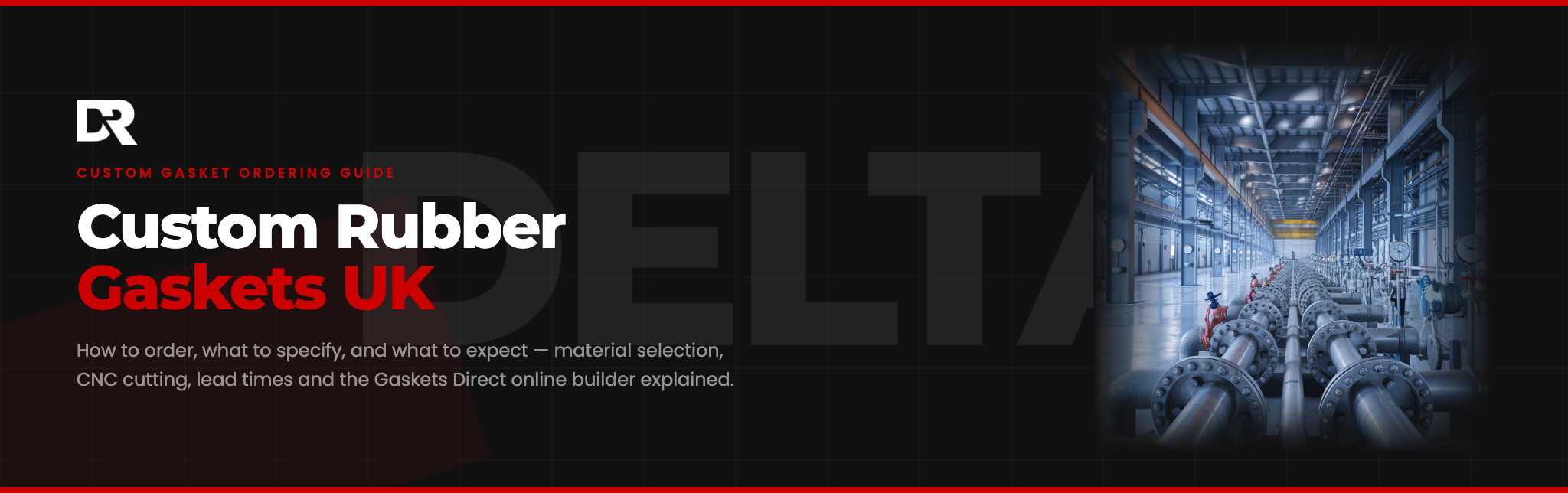
Custom Rubber Gaskets UK: How to Order, What to Specify, and What to Expect
Custom rubber gaskets are sealing components cut or moulded to a profile that differs from any standard off-the-shelf size. In UK industrial practice, “custom” covers three distinct scenarios: a simple shape cut from sheet rubber using CNC equipment, a complex profile produced from a DXF file or engineering drawing, and a fully moulded gasket for high-volume repeating applications. Understanding which category your requirement falls into determines your lead time, your tooling cost, and how you should submit your enquiry.
Delta Rubber Limited has produced custom rubber gaskets for UK engineering, maintenance, and manufacturing clients since 2007. Whether you have a worn gasket on your workbench, a DXF file ready to send, or a flange reference from a datasheet, this guide walks you through every step of the ordering process.
What Is a Custom Rubber Gasket?
When off-the-shelf won’t do
Standard rubber gaskets cover common pipe flange dimensions — PN6, PN10, PN16, ANSI 150, and a handful of others. They work perfectly for most pipework installed to those standards. The problem arises with non-standard flanges, older equipment manufactured to imperial dimensions, bespoke machinery, or any application where the seal must conform to a unique profile.
Maintenance engineers most commonly encounter this situation when replacing a gasket on equipment where the OEM part is no longer available. Project engineers encounter it when specifying sealing for new equipment to a unique design. In both cases, a custom-cut or custom-moulded gasket is the only solution.
The difference between standard, cut-to-size, and fully bespoke
There is a practical hierarchy of complexity — and cost — in custom gasket production:
Cut-to-size (simple shapes): Ring gaskets, rectangular gaskets, and basic profiles cut from rubber sheet. These require no tooling, minimal setup, and can often be produced the same day if material is in stock. This is the most common custom gasket type.
Complex profile (CNC cut from DXF): Irregular shapes, multi-hole gaskets, profiles with tight tolerances. Produced on CNC cutting equipment (Zund machines are the UK industry standard). Still no tooling charge — the DXF file replaces the die. Lead time: typically 1–3 working days.
Moulded gaskets: For high volumes where consistent compression properties and dimensional repeatability are critical. Requires tooling (typically £500–£2,000 depending on complexity), longer lead time (3–6 weeks for tooling), and minimum volumes that make the tooling cost viable. Not the right choice for low-quantity or urgent requirements.
Step 1 — Choosing the Right Material
Material selection is the most consequential decision in the gasket specification process. Get it wrong and the gasket fails — potentially damaging equipment, causing leaks, or creating a safety incident.
The correct approach is to work from the application, not the material catalogue.
EPDM — water, steam and weather-resistant applications
EPDM rubber (Ethylene Propylene Diene Monomer) is the standard choice for gaskets sealing water, steam, and outdoor-exposed joints. It offers an operating temperature range of -40°C to +120°C continuous, with excellent resistance to ozone, UV, and weathering. WRAS-approved EPDM grades are available for drinking water contact — essential for plumbing and potable water applications under UK Water Regulations.
Use EPDM when: the sealed medium is water, steam, dilute acids or alkalis, or the gasket is exposed to outdoor weathering.
Do not use EPDM when: the medium contains petroleum oils or fuels. EPDM has essentially no oil resistance and will swell and fail rapidly in hydrocarbon contact.
Nitrile (NBR) — oil, fuel and grease resistance
Nitrile rubber (NBR, nitrile butadiene rubber) is the engineering standard for oil and fuel-contact applications. Its acrylonitrile (ACN) content — typically 28–34% in commercial sheet — determines oil resistance. Higher ACN content means greater oil resistance but reduced flexibility at low temperatures.
Use Nitrile when: the sealed medium is petroleum oil, mineral oil, hydraulic fluid, diesel, petrol, or grease. Also appropriate for general engineering applications where the medium is not aggressive.
Operating range: -30°C to +120°C continuous.
Neoprene — general purpose with moderate chemical resistance
Neoprene (polychloroprene) sits between EPDM and Nitrile in the material hierarchy — offering moderate oil resistance alongside good weathering performance. It’s a practical choice when the application is not clearly oil-contact or water-contact, and where a single material needs to handle varied conditions.
Operating range: -40°C to +120°C.
Viton (FKM) — aggressive chemicals and high temperatures
Viton (fluorocarbon rubber, FKM) is the specified material when the application involves aggressive chemicals, solvents, or temperatures above 120°C. It is significantly more expensive than NBR or EPDM — but where these conditions apply, no other common elastomer matches its resistance profile.
Operating range: -20°C to +200°C continuous.
Silicone — food, pharmaceutical and extreme temperature applications
Silicone rubber offers the widest operating temperature range of any common elastomer: -60°C to +220°C. FDA-compliant and food-safe grades are standard. Commonly specified in food processing, pharmaceutical manufacturing, and healthcare equipment where hygiene standards prohibit carbon-black-filled rubbers.
Operating range: -60°C to +220°C.
Non-rubber options: cork, CNAF, and bonded materials
Delta also supplies non-rubber gasket materials: compressed non-asbestos fibre (CNAF) for high-pressure/high-temperature applications such as flanged joints in steam systems; cork and rubber composite for vibration-damping and low-pressure sealing; and bonded cork/paper for automotive and light engineering use.
Material selection summary
| Material | Best For | Avoid When |
|---|---|---|
| EPDM | Water, steam, outdoor, weather | Oil or fuel contact |
| Nitrile (NBR) | Oil, fuel, hydraulic fluid | High temperature (>120°C), outdoor use |
| Neoprene | General purpose, moderate oil/weather | Aggressive chemicals, strong solvents |
| Viton (FKM) | Aggressive chemicals, high temperature | Cost is a constraint and conditions don’t require it |
| Silicone | Food/pharma, extreme temperatures | Oil and fuel, abrasion-heavy applications |
| CNAF | High-pressure steam, industrial pipework | Low-pressure or dynamic sealing |

Step 2 — Defining Your Gasket Dimensions
Buyers consistently report this as their greatest source of uncertainty. It need not be. Delta and Gaskets Direct can work from any of the following:
Working from an existing gasket (measuring technique)
Use calibrated vernier calipers — not a ruler. Measure:
– Inner diameter (ID): the inside hole diameter
– Outer diameter (OD): the outermost edge
– Any bolt hole positions: pitch circle diameter (PCD) and hole diameter
– Thickness: measure with calipers, not by feel
Note that worn or compressed gaskets may measure slightly undersized. Cross-reference your measurements against the nearest standard flange size where the application is a standard pipe flange.
Working from a drawing or DXF file
A DXF (Drawing Exchange Format) file from CAD software is the cleanest way to submit a complex gasket profile. It eliminates measurement error entirely and can be loaded directly into CNC cutting software. PDF drawings are also accepted — Delta’s team can digitise them if required.
If you have an engineering drawing with tolerances, include those explicitly. Standard CNC cutting achieves ±0.5mm on complex profiles; tighter tolerances are achievable on request.
Working from a flange standard (PN/ANSI/BS)
If your gasket seals a standard flanged joint, reference the standard directly:
– PN (Pressure Nominal): European metric standard. PN6, PN10, PN16, PN25, PN40 are the most common in UK industry.
– ANSI/ASME B16.21: American flange standard — common on US-origin process equipment. B16.20 for ring-type joints.
– BS EN 1514: Dimensions for flanges and their joints; the current UK/European pipeline standard.
For bolted flanged joints to these standards, gasket dimensions can be calculated directly from the nominal pipe size and pressure class — no measurement of an existing part is required.
Step 3 — Specifying Thickness
Gasket thickness affects sealing performance under compression. Too thin, and the gasket may not conform adequately to flange surface irregularities. Too thick, and the bolt load is distributed across a greater volume, reducing sealing stress.
Standard thicknesses available
- 1.5mm: Thin precision gaskets, lightweight flanges, low-pressure sealing
- 3mm: The most common specification for standard industrial flanged joints — suitable for the majority of applications
- 4.5mm: Where additional compliance or surface conformance is needed
- 6mm: Higher-pressure applications, rough flange surfaces, vibration-prone joints
- 8mm–12mm: Heavy engineering, non-standard flanges with wide face seating
When in doubt, specify 3mm for a standard bolted flange application and increase to 6mm only if the flange face is rough or the joint experiences thermal cycling.
How Gaskets Are Made — CNC Cutting vs Die Cutting vs Waterjet
CNC (Zund) cutting — the UK standard for custom orders
Zund cutting systems use oscillating blades guided by CNC to cut gaskets directly from sheet rubber with no tooling die required. The file is loaded, the sheet is positioned, and cutting begins — often within minutes of order confirmation.
For Delta’s UK customers, this translates to:
– No tooling charge — the DXF file replaces the die
– One-piece and low-volume orders are economically viable — the economics of CNC cutting are the same for one gasket or fifty
– Fast turnaround — for materials held in stock, same-day and next-day cutting is achievable
Die cutting — for high-volume repeating orders
Die cutting uses a pressed steel rule die to punch gaskets from sheet material. Once the die is made, cutting is fast and consistent. The tooling cost (typically £200–£600 for a simple ring gasket die) only becomes economic at volumes where that upfront cost is amortised — generally 500+ pieces of the same part.
For most custom gasket requirements in UK industrial and maintenance contexts, CNC cutting is the right choice. Die cutting is relevant for OEM component supply where the same gasket is manufactured in large quantities repeatedly.
Why CNC is the default for UK custom gasket orders
The economics are straightforward: CNC cutting requires no tooling investment, allows any profile that fits within the sheet dimensions, accommodates design changes at zero cost, and is fast. UK buyers — especially those with urgent maintenance requirements — benefit from CNC’s flexibility and speed in a way that traditional cutting methods cannot match.
Lead Times, Minimum Orders and Pricing
What affects lead time
The primary variables are:
1. Material availability: Stock materials (EPDM, Nitrile, Neoprene in standard thicknesses) are cut the same or next working day. Non-stock grades require procurement first — add 2–5 days.
2. Profile complexity: Simple ring gaskets are cut in minutes. Complex multi-hole profiles take longer per piece, but setup time is fixed regardless of quantity.
3. Order volume: Very large orders may require scheduling.
Typical lead times for CNC-cut gaskets
- Standard materials from stock: 1–3 working days for delivery across mainland UK
- Non-stock or specialist materials: 3–7 working days
- Complex profiles from DXF: Add 1 working day for file validation and setup
For urgent requirements, contact Delta directly — same-day cutting of in-stock materials is frequently possible for orders received before midday.
Minimum order quantities
This is where CNC cutting fundamentally differs from die cutting: there is no minimum quantity requirement. A single custom-cut gasket is as economical to produce as a batch of ten from a CNC perspective (the file setup and machine time per piece are proportionally higher for single pieces, reflected in per-piece pricing, but there is no tooling barrier to ordering one).
This makes CNC-cut custom gaskets viable for:
– One-off urgent replacements
– Prototype and development quantities
– Small-batch maintenance stock
How pricing is calculated
CNC-cut gasket pricing is based on:
– Material cost (type, thickness, grade)
– Profile complexity (cutting time per piece)
– Quantity (per-piece cost decreases with volume due to fixed setup)
For standard ring gaskets in common materials, prices are typically calculable instantly using an online gasket builder. For complex profiles, a quote is generated from the DXF file.
How to Place a Custom Gasket Order — The Gaskets Direct Process
Gaskets Direct is Delta Rubber’s dedicated custom gasket ordering platform. It is designed to remove every barrier between a buyer with a gasket requirement and a finished part in their hands.
Online gasket builder — build your gasket in minutes
For ring gaskets (the most common type), the Gaskets Direct builder allows you to:
1. Enter inner diameter, outer diameter, and bolt hole positions
2. Select material (EPDM, Nitrile, Neoprene, Viton, Silicone, and more)
3. Choose thickness
4. Get an instant price
5. Add to cart and check out
No phone calls. No waiting for a quote. No minimum order. For straightforward ring gaskets, the entire process from measurement to order takes under five minutes.
Upload a DXF or drawing
Complex profiles — multi-hole gaskets, irregular shapes, non-standard profiles — can be submitted by uploading a DXF file directly via the Gaskets Direct platform. Delta’s engineering team reviews the file, confirms cutting feasibility, and returns a quote.
If you don’t have a DXF file but have a dimensioned drawing or even a scanned image of an existing gasket with measurements, upload that instead. Delta can work with it.
Request a quote for complex or high-volume requirements
For CNAF, Viton, moulded gaskets, or high-volume orders where bespoke pricing is appropriate, the Delta Rubber custom gaskets page provides a direct quote request route with a technical team response.
Frequently Asked Questions
How do I order a custom rubber gasket in the UK?
To order a custom rubber gasket in the UK, provide your supplier with the gasket dimensions (inner diameter, outer diameter, thickness, and any bolt hole positions), the material required, and your quantity. Suppliers using CNC cutting equipment — such as Gaskets Direct — can produce gaskets from a DXF file, a physical sample gasket, or callipered measurements. There is no tooling charge and no minimum order quantity, making single-piece orders as practical as batch orders.
What is the lead time for custom rubber gaskets in the UK?
For CNC-cut rubber gaskets with material held in stock, typical lead times are 1–3 working days for mainland UK delivery. Complex profiles or specialist materials may take 3–5 working days. Contact Delta Rubber directly for urgent requirements — same-day cutting is often possible for orders placed before midday.
Can I get a single custom rubber gasket made in the UK?
Yes. CNC cutting technology requires no tooling die, meaning a single gasket is as feasible to produce as a batch of 500. Gaskets Direct supplies one-off custom gaskets regularly — often for urgent maintenance requirements where no OEM replacement is available.
What rubber material should I use for a gasket?
The correct material depends on the sealed medium and temperature: EPDM for water, steam, and outdoor applications; Nitrile (NBR) for oil and fuel contact; Viton (FKM) for aggressive chemicals and temperatures above 120°C; Silicone for food-contact and pharmaceutical applications. When the medium is mixed or unclear, Neoprene is a practical general-purpose choice.
What if I don’t have a drawing — can I just send a worn gasket?
Yes. A physical sample gasket can be measured and replicated. Include calipered measurements of inner diameter, outer diameter, and thickness if possible — worn gaskets may have compressed slightly, and measurements help Delta confirm the correct specification before cutting.
What is the difference between CNC cutting and die cutting for gaskets?
CNC cutting uses a computer-controlled blade to cut gaskets from sheet material directly from a digital file — no tooling die required, any profile, any quantity including single pieces. Die cutting presses a steel-rule tool through sheet material — fast and repeatable for large volumes but requires a tooling die (typically £200–£600) that makes low-quantity orders uneconomical. For most UK custom gasket requirements, CNC cutting is the right method.
Delta Rubber has supplied custom gaskets to UK engineering, manufacturing, and maintenance teams across every major industry sector. The Gaskets Direct online platform makes ordering straightforward: build standard ring gaskets instantly, upload DXF files for complex profiles, and receive CNC-cut gaskets in as little as one working day. For high-volume or technically complex requirements, the Delta team provides full specification support — contact us via deltarubber.co.uk/custom-gaskets.