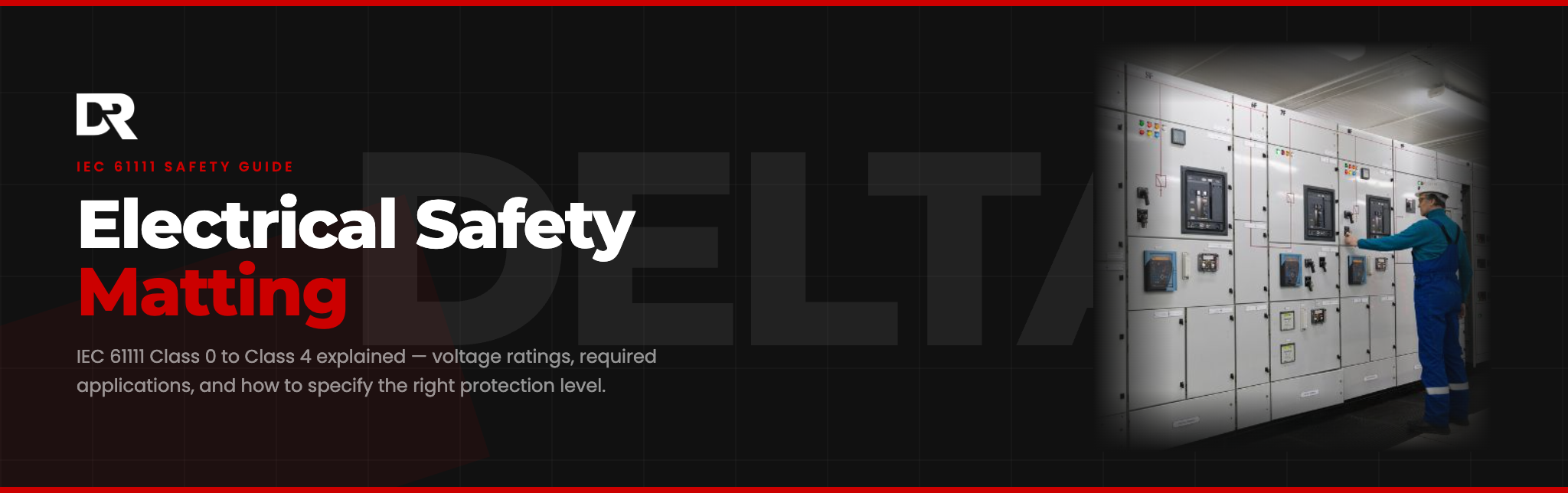
Electrical Safety Matting: IEC 61111 Classes Explained — Which Class Do You Need?
Electrical safety matting is specialist rubber insulation matting designed to protect personnel working on or near live electrical equipment by providing a dielectric barrier between the operative and earth. Governed in the UK by BS EN 61111:2009 (the British adoption of IEC 61111:2009), the standard defines five insulation classes — Class 0 through Class 4 — each rated for a specific maximum working voltage. Selecting the wrong class is not a minor administrative error; it is a compliance failure with direct safety consequences under the Electricity at Work Regulations 1989.
The five classes cover working voltages from 1,000V AC (Class 0) up to 36,000V AC (Class 4). Each class has mandatory minimum thickness and physical performance requirements, and mats must be visually inspected before every use with periodic electrical re-testing — typically annually. If you are specifying matting for a substation, switchroom, transformer bay, or any live-working environment, this guide gives you the class ratings, decision criteria, and inspection obligations you need.
What Is Electrical Safety Matting and Why Is It Required?
Electrical safety matting is vulcanised rubber matting manufactured to provide electrical insulation underfoot. The rubber compound used must meet the dielectric performance requirements set out in BS EN 61111:2009 across its rated voltage class — not just at the point of manufacture, but throughout its service life under periodic re-testing.
The legal requirement to provide appropriate insulation in electrical working areas flows directly from the Electricity at Work Regulations 1989, specifically Regulation 13 (precautions for work on equipment made dead) and Regulation 14 (work on or near live conductors). The HSE’s supporting guidance document HSG85: Electricity at Work — Safe Working Practices references IEC 61111 directly as the applicable standard for insulating matting used in conjunction with live electrical work.
Under the Electricity at Work Regulations, employers and self-employed persons have a duty to take precautions to prevent injury from electrical hazards. Where personnel are required to work at or near exposed live conductors — switchgear, distribution boards, transformer connections, busbar chambers — insulating matting rated to the correct class is a fundamental control measure. Relying on general-purpose or anti-fatigue matting in these areas is a regulatory breach, regardless of the rubber content of the mat.
The standard itself was last revised in 2009 (IEC 61111:2009, adopted as BS EN 61111:2009 in the UK), replacing the earlier 1994 edition. Organisations working to the older standard should verify their matting stock and testing protocols align with the current edition.

IEC 61111:2009 — The Current UK Standard (BS EN 61111:2009)
BS EN 61111:2009 is the definitive technical standard for electrical insulating matting for use in electrical installations. The standard covers:
- Classification of matting into five voltage classes (0 through 4)
- Minimum dielectric strength requirements at each class
- Physical and mechanical property requirements (thickness, tear strength, tensile strength)
- Ozone resistance requirements
- Test methods for new mats and for periodic re-testing in service
The standard specifies that mats are tested at proof voltage — a test voltage significantly higher than the rated maximum use voltage — to verify the dielectric integrity of the material. For example, a Class 0 mat rated for use up to 1,000V AC must withstand a proof test at 5,000V AC without puncture or breakdown.
One important point for UK buyers: following the UK’s departure from the EU, BS EN 61111:2009 remains the applicable standard. The standard has not been replaced or revised as of 2026, and UKCA marking requirements for PPE apply to matting sold as personal protective equipment in the GB market. Buyers should confirm that supplied matting carries current test certification to BS EN 61111:2009 and not certification to the superseded 1994 edition.
The Five IEC 61111 Classes Explained
Class 0 — Up to 1,000V AC / 1,500V DC
Class 0 is the most widely specified class in commercial and industrial electrical installations in the UK. It covers working environments where the maximum system voltage does not exceed 1,000V AC or 1,500V DC — which covers the majority of low-voltage switchgear, industrial motor control centres, distribution boards, and commercial LV switchrooms operating at 230V or 400V.
The proof test voltage for Class 0 matting is 5,000V AC. Minimum thickness is typically 4mm, though manufacturer specifications vary. Class 0 matting is most commonly produced in black, though this is a convention rather than a standard requirement — always specify by class number, not colour.
For the majority of facilities management, industrial maintenance, and electrical contracting work on standard LV installations, Class 0 is the correct specification. If your working voltage never exceeds 1,000V AC, there is no technical justification for specifying a higher class — though higher classes will always satisfy a lower voltage requirement.
Class 1 — Up to 7,500V AC / 11,250V DC
Class 1 matting is rated for working environments up to 7,500V AC. The proof test voltage is 10,000V AC. Typical applications include medium voltage secondary switchgear, ring main units, and certain industrial drive equipment operating above 1kV. Cable jointing work on 6.6kV distribution systems would typically require Class 1 matting as a minimum.
Minimum thickness at Class 1 is generally 5mm. Colour coding at this class varies by manufacturer — some suppliers produce Class 1 in red, others in contrasting colours to distinguish from Class 0 stock. Again: specify by class number, not colour.
Class 2 — Up to 17,000V AC / 25,500V DC
Class 2 covers voltages up to 17,000V AC and carries a proof test voltage of 20,000V AC. Relevant applications include 11kV primary switchgear, transformer tap changing positions, and 11kV cable termination bays — equipment that is standard in UK utility substations and large industrial primary substations.
Minimum mat thickness increases at this class to accommodate the higher dielectric requirements. Class 2 matting is a common specification for DNO (Distribution Network Operator) substation access points and for contractors working on 11kV equipment.
Class 3 — Up to 26,500V AC / 39,750V DC
Class 3 matting is rated for working voltages up to 26,500V AC, proof tested at 30,000V AC. At this level the matting is relevant to 22kV distribution systems and higher-voltage industrial applications such as steel production, large petrochemical sites, and railway traction power infrastructure operating at 25kV AC.
Thickness and physical specification requirements at Class 3 are more demanding, reflecting both the higher voltage rating and the environments in which this class is typically deployed.
Class 4 — Up to 36,000V AC / 54,000V DC
Class 4 is the highest rating under IEC 61111:2009, covering working voltages up to 36,000V AC and proof tested at 40,000V AC. Applications are confined to high-voltage transmission infrastructure: 33kV bulk supply points, primary substations, and EHV equipment operated by transmission network operators. Class 4 matting is uncommon outside specialist utility and transmission engineering work.
IEC 61111 Class Comparison Table
| Class | Max Working Voltage (AC) | Max Working Voltage (DC) | Proof Test Voltage (AC) | Typical Application |
|---|---|---|---|---|
| 0 | 1,000V | 1,500V | 5,000V | LV switchgear, distribution boards, 230/400V motor control |
| 1 | 7,500V | 11,250V | 10,000V | MV secondary switchgear, 6.6kV cable jointing |
| 2 | 17,000V | 25,500V | 20,000V | 11kV primary switchgear, DNO substations |
| 3 | 26,500V | 39,750V | 30,000V | 22kV distribution, 25kV railway traction, HV industrial |
| 4 | 36,000V | 54,000V | 40,000V | 33kV bulk supply points, EHV transmission infrastructure |
Note: Colour coding varies by manufacturer. Always specify matting by IEC 61111 class number, not by colour.
Which Class Do You Need?
The selection rule is straightforward: the matting class must be rated for the maximum system voltage present in the working area, not the nominal operating voltage of the equipment you are working on. You are providing protection against the worst-case voltage to which you could be exposed in that environment.
Follow this decision framework:
Step 1 — Establish the maximum system voltage. For most UK industrial and commercial LV work (230V single phase, 400V three phase), the maximum system voltage is 1,000V AC. Class 0 applies.
Step 2 — Identify whether any MV or HV equipment is present in the same area. If a switchroom contains both LV and 11kV equipment, the matting must be rated for 11kV — Class 2 minimum — even if the specific task is on the LV equipment.
Step 3 — Check your working procedure. Permit to Work systems and safe systems of work may specify a higher class than the minimum standard requires. Where the procedure specifies a class, use it.
Step 4 — Verify the mat’s certification. A mat without current BS EN 61111:2009 test certification is not compliant, regardless of its physical appearance or stated class. Request the test certificate at the point of purchase and retain records.
A common error is specifying by nominal system voltage rather than maximum system voltage. A 400V LV system has a maximum voltage of 1,000V AC under the standard, so Class 0 is correct. Specifying a mat rated only to 400V with no class reference is not a valid approach under BS EN 61111:2009.
Thickness and Physical Specifications at Each Class
IEC 61111:2009 sets minimum requirements for thickness and physical performance properties. Matting must meet these requirements to achieve its class rating — thickness alone does not determine class. A thicker mat does not automatically qualify for a higher class rating; it must pass the dielectric proof test at the relevant voltage.
Typical minimum thickness values by class:
- Class 0: 4mm minimum
- Class 1: 5mm minimum
- Class 2: 6mm minimum
- Class 3: 8mm minimum
- Class 4: 10mm minimum
Physical properties specified in the standard include tensile strength, elongation at break, tear strength, and ozone resistance. Ozone resistance is a practical requirement: electrical switchrooms often contain ozone-generating equipment, and matting that degrades under ozone exposure will lose both mechanical integrity and dielectric performance over time.
Roll widths of 1,000mm and 1,200mm are standard for most classes. Length can be cut to suit the specific bay or switchboard area requiring coverage.
Testing and Inspection Requirements
Compliance does not end at the point of purchase. BS EN 61111:2009 and the associated guidance under HSG85 establish ongoing inspection and testing requirements that operators must meet.
Before each use: A visual inspection is mandatory before laying the mat. Remove from service immediately if any of the following are present:
- Cuts, punctures, or splits in the surface
- Embedded conductive contamination (metalswarf, wire fragments)
- Contamination with conductive liquids (water, cutting fluid, electrolyte)
- Surface cracking, crazing, or signs of ozone degradation
- Folding creases that have created permanent deformation or micro-cracking
Periodic electrical re-testing: Mats should be electrically re-tested at intervals not exceeding 12 months to verify that dielectric performance remains within the class specification. Re-testing is carried out against the proof voltage for the relevant class. A mat that fails re-test must be destroyed and replaced — it cannot be downgraded to a lower class.
Storage: Store mats flat or rolled (not folded) away from UV, ozone sources, heat, and solvents. Folding creates stress concentrations at the fold line that can initiate surface cracking and compromise dielectric integrity.
Labelling: Mats must retain legible class labelling throughout their service life. A mat with obliterated or removed class marking cannot be confirmed as compliant and should be withdrawn from service.
Where Is Electrical Safety Matting Required?
Electrical safety matting under IEC 61111:2009 is required wherever personnel work on or near live electrical equipment in excess of 50V AC or 120V DC ripple-free. Specific applications where it is routinely deployed include:
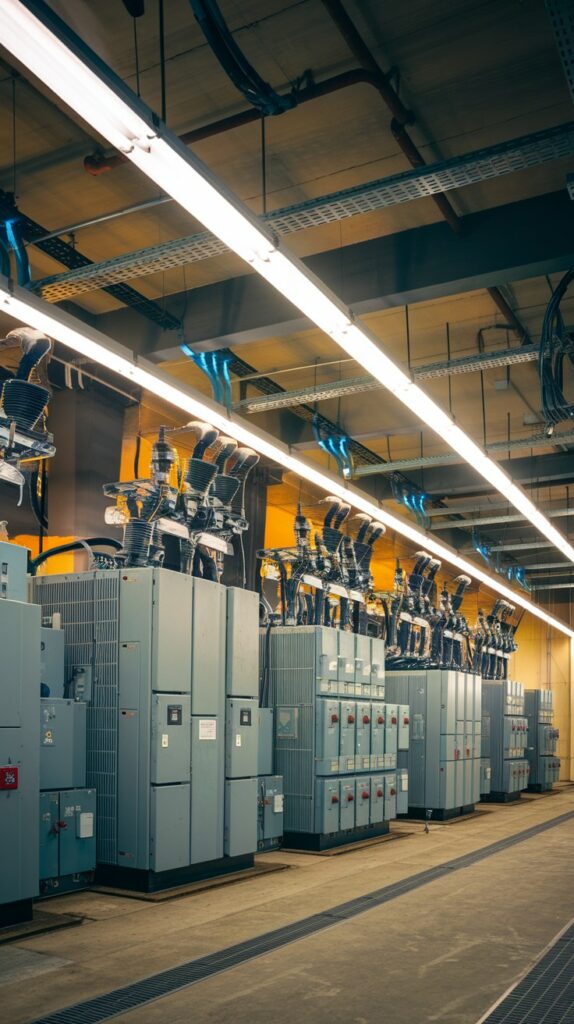
- LV and HV switchrooms and switchgear bays
- Transformer bays and tap changer positions
- Motor control centres (MCCs) and variable speed drive enclosures
- Distribution board and busbar chamber access
- Battery rooms and DC busbars in UPS installations
- Electrical test laboratories and high-potential test bays
- DNO and utility substation access walkways
- Railway traction power equipment rooms
- Offshore platform electrical equipment rooms
In each case, the mat should cover the full standing area in front of the equipment, with sufficient overlap to ensure no uninsulated floor contact is possible during the task. Guidance in HSG85 recommends mats extend at least 600mm in front of the panel, though this should be confirmed against the specific working procedure.
Common Mistakes: Why You Must Not Confuse Anti-Fatigue Matting with Electrical Safety Matting
The most dangerous misconception in electrical matting specification is treating anti-fatigue matting, general-purpose rubber matting, or “insulating” matting without class certification as equivalent to IEC 61111-compliant electrical safety matting. They are not equivalent, and the difference is the difference between compliant protection and no protection at all.
Anti-fatigue matting is designed to reduce standing fatigue. It may be made from rubber, foam rubber, or composite materials. It has no dielectric specification, no voltage class rating, and no proof test certification. Placing anti-fatigue matting in front of a live switchboard does not satisfy the requirements of the Electricity at Work Regulations 1989.
Similarly, general-purpose rubber matting — including heavy-duty workshop matting or entrance matting — may be made from natural or synthetic rubber compounds, but the compound formulation and thickness are optimised for wear resistance and grip, not dielectric performance. A mat with no IEC 61111 class certification provides no reliably quantifiable insulation.
The visual similarity between anti-fatigue matting and Class 0 electrical safety matting means incorrect substitution is an easy mistake. Both are typically black, both are rubber, and both look functionally identical to a non-specialist. The difference only becomes apparent at the point of specification — or in the event of a flashover.
For your general-purpose industrial rubber matting requirements, Delta carries a full range of workshop and commercial floor matting. For electrical safety applications, only IEC 61111-certified matting is appropriate.
Frequently Asked Questions
What does IEC 61111 Class 0 mean? Class 0 is the lowest voltage class under IEC 61111:2009 (BS EN 61111:2009), rated for use in environments where the maximum system voltage does not exceed 1,000V AC or 1,500V DC. It is the most widely used class for LV switchgear, distribution boards, and motor control centres operating at 230V or 400V. Class 0 mats are proof tested at 5,000V AC before sale.
How often does electrical safety matting need to be tested? BS EN 61111:2009 requires mats to undergo electrical re-testing (proof testing) at intervals not exceeding 12 months. Before each use, a visual inspection for cuts, contamination, cracking, or damage is mandatory. Any mat that fails either a visual inspection or a periodic re-test must be withdrawn from service and destroyed.
Can I use the same mat for all voltage classes? No. A mat certified to Class 2 (17,000V AC) can be used in Class 0 or Class 1 environments, because the higher rating encompasses the lower voltage. However, a Class 0 mat cannot be used where a Class 1 or higher rating is required. Always match the mat class to the maximum system voltage in the working area.
Is colour coding reliable for identifying IEC 61111 mat classes? No. Colour coding varies between manufacturers and is not defined by the standard as a mandatory classification method. Black is conventional for Class 0 and some Class 1 mats, but other colours (red, yellow, orange, white) are used inconsistently across different manufacturers. Always identify class from the legible class marking on the mat itself and the accompanying test certificate, not by colour.
What makes electrical safety matting different from ordinary rubber matting? Electrical safety matting is manufactured from a dielectric rubber compound formulated specifically for electrical insulation performance, and each batch is proof tested to verify dielectric integrity. Ordinary rubber matting — including anti-fatigue, entrance, or workshop matting — has no dielectric specification and provides no quantifiable electrical insulation. Using non-certified matting in live electrical working areas is a breach of the Electricity at Work Regulations 1989.
Does electrical safety matting expire? Mats do not have a fixed calendar expiry date, but they are subject to annual electrical re-testing requirements. Physical degradation from UV, ozone, contamination, mechanical damage, or improper storage can render a mat non-compliant before its first annual re-test. A mat that fails any visual inspection or periodic re-test must be taken out of service immediately, regardless of its age.
Specifying the correct IEC 61111 class for your working environment is a straightforward process when you match the mat class to the maximum system voltage present — not just the nominal operating voltage of the equipment. Class 0 covers the majority of UK LV electrical installations, while Classes 1 through 4 address progressively higher MV and HV working environments. Annual re-testing and rigorous pre-use inspection are non-negotiable obligations, not optional best practice.
Delta Rubber supplies electrical safety matting certified to BS EN 61111:2009 across all standard classes, available to cut to length from our online shop or through our technical sales team who can advise on the correct class for your specific installation.