EPDM Rubber Sheet: The Complete UK Buyer’s Guide — Properties, Thicknesses and Applications
EPDM rubber sheet (Ethylene Propylene Diene Monomer) is the UK’s standard material for any sealing, lining, or weatherproofing application involving water, steam, or outdoor exposure. Its defining property — outstanding resistance to UV radiation, ozone, and atmospheric weathering — is why it is specified from building expansion joints to HVAC gaskets, automotive weatherstrip to pond liners. No common elastomer degrades more slowly in outdoor conditions.
This guide covers the material science behind EPDM’s performance, how it compares to neoprene and nitrile rubber sheet, how to select the right grade and thickness, and how to order cut-to-size from a UK stock supplier. It focuses on industrial and sealing applications — not roofing membrane systems, which are a specialist product category served by dedicated roofing suppliers.
What Is EPDM Rubber? (The Short Version)
What “EPDM” stands for and why it matters
EPDM stands for Ethylene Propylene Diene Monomer. The ethylene and propylene backbone gives the material its inherent stability — the polymer chain is fully saturated except at the diene modification sites, which means atmospheric oxygen and ozone cannot attack the main chain and cause degradation. This is the mechanism behind EPDM’s exceptional weathering performance.
Under ISO 1629 — the international standard for rubber nomenclature — EPDM is classified in the M-group (saturated backbone, modified), which is the same class as silicone, Viton, and PTFE rubbers. The M-group designation signals inherent chemical stability in the polymer structure itself, not just an additive or surface treatment.
Why EPDM is one of the UK’s most widely used rubber materials
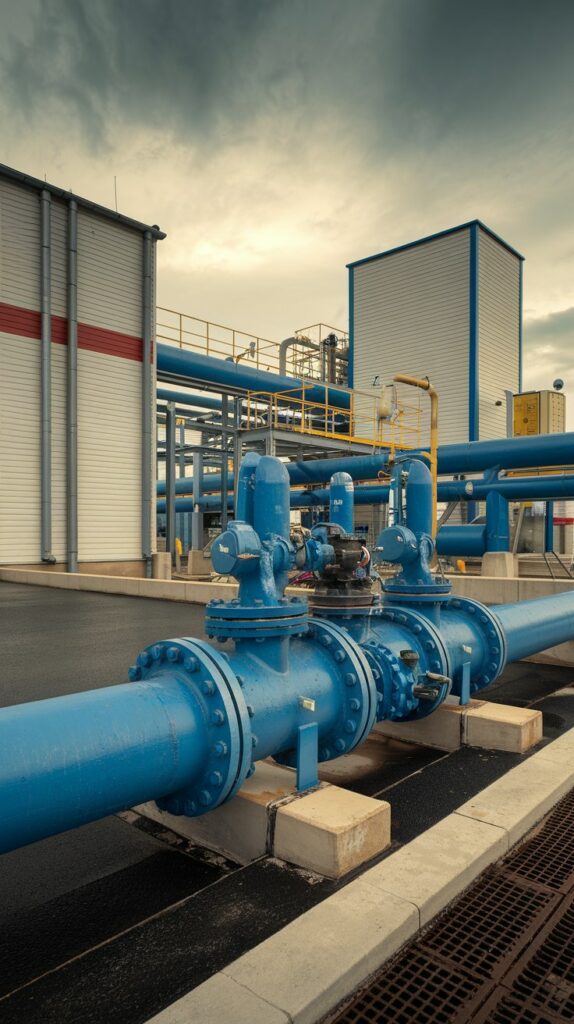
The UK climate makes weathering resistance a practical priority for a wide range of applications: outdoor building joints, rooftop plant seals, HVAC penetrations, and automotive weatherstrip all involve sustained outdoor exposure. Combined with EPDM’s compatibility with water and steam — the most common industrial sealed media — the material is applicable across more UK engineering scenarios than any other general-purpose elastomer.
WRAS-approved EPDM grades (Water Regulations Advisory Scheme) are available for direct potable water contact, making EPDM the standard in domestic and commercial plumbing installations as well as water treatment and utilities infrastructure.
Key Properties of EPDM Rubber Sheet
Weather, UV and ozone resistance — EPDM’s defining strength
EPDM’s weathering performance is exceptional and measurable. Accelerated weathering tests (per ASTM D750 and ISO 4665) demonstrate that EPDM sheet retains mechanical properties — hardness, elongation, and tensile strength — after UV and ozone exposure that degrades nitrile, natural rubber, and SBR within weeks. In real-world UK outdoor conditions, properly formulated EPDM sheet lasts 20+ years without significant surface degradation.
This performance is structural, not additive — the saturated EPDM backbone resists atmospheric attack regardless of the specific compound formulation. This distinguishes it from ozone-protected neoprene or SBR compounds, where the UV protection is achieved by additives that can deplete over time.
Temperature range — from -40°C to +120°C
EPDM rubber sheet operates across a continuous service range of -40°C to +120°C, with short-term exposure tolerance to +150°C. The low-temperature flexibility is particularly useful in UK outdoor installations, where winter temperatures can challenge seals that only perform adequately at ambient conditions.
For applications requiring sustained temperatures above 120°C — high-pressure steam systems, certain industrial process applications — silicone or Viton rubber provides the required temperature margin. For the majority of HVAC, water supply, and building sealing applications, EPDM’s temperature range is more than adequate.
Chemical resistance (water, steam, dilute acids and alkalis)
EPDM resists water, steam, dilute acids, dilute alkalis, ketones (acetone, MEK), and most polar solvents. This makes it suitable for water treatment applications, steam sealing in low-to-medium pressure systems, and chemical processing where the media are relatively mild.
Under BS EN 682:2002+A1:2012 — the European standard for elastomeric seals for pipe joints conveying water and drainage — EPDM is the standard compliant material for water infrastructure sealing. UK water utilities and building services contractors specify EPDM as their default pipe joint seal material accordingly.
Electrical insulation properties
EPDM exhibits good electrical insulation properties, with volume resistivity typically in the range of 10¹⁴ to 10¹⁶ Ω·cm for standard black-filled grades. This makes EPDM sheet suitable as an insulating liner or separator in electrical switchgear housings and control panel applications where the primary requirement is weatherproofing and the secondary requirement is basic electrical isolation.
For dedicated electrical safety matting applications requiring certified IEC 61111 compliance, Delta’s electrical safety matting range provides the appropriate certified product.
What EPDM does NOT resist — oils and fuels
EPDM has essentially no resistance to petroleum oils, mineral oils, fuels, or hydrocarbon solvents. This is the critical misapplication risk: buyers who select EPDM on price or familiarity for an oil-contact application will experience rapid gasket failure — the EPDM absorbs hydrocarbons, swells, softens, and loses mechanical integrity within days or weeks.
For oil, fuel, or hydraulic fluid applications, specify nitrile rubber (NBR). For aggressive chemical or high-temperature oil applications, specify Viton (FKM). EPDM has no role in oil-contact sealing.
EPDM vs Other Rubber Sheet Materials
EPDM vs Neoprene — weather vs versatility
| Property | EPDM | Neoprene |
|---|---|---|
| Weather/UV resistance | Excellent | Good |
| Ozone resistance | Excellent | Good |
| Water/steam resistance | Excellent | Good |
| Oil resistance | Poor | Moderate |
| Temperature range | -40°C to +120°C | -40°C to +120°C |
| General versatility | Good (water-based applications) | Very good (general purpose) |
EPDM wins clearly on weather, UV, and steam resistance. Neoprene offers moderate oil resistance that EPDM lacks entirely, making neoprene the practical choice where the application is genuinely ambiguous — some oil exposure but primarily water or outdoor conditions. Where the application is clearly oil-free and outdoor or water-based, EPDM is the correct specification.
EPDM vs Nitrile — weather vs oil resistance
These two materials are essentially opposites in their resistance profiles: EPDM excels where nitrile fails (weather, UV, steam), and nitrile excels where EPDM fails (oils and fuels). There is no application where both are acceptable — the choice is always dictated by the sealed medium.
Outdoor sealing, water, steam → EPDM.
Oil, fuel, hydraulic fluid → Nitrile.
Mixing these up is the most expensive material selection error in rubber engineering. A nitrile gasket in a steam service will harden and crack; an EPDM gasket in oil service will swell and extrude from the joint.
EPDM vs Silicone — the temperature range trade-off
Silicone rubber extends the temperature range significantly beyond EPDM: -60°C to +220°C vs EPDM’s -40°C to +120°C. For food-contact applications or pharmaceutical sealing where FDA compliance is required, silicone is the standard material. EPDM is not inherently food-safe in standard black-filled grades, though WRAS-approved and FDA-compliant EPDM grades exist.
For most outdoor and water-contact applications within the -40°C to +120°C range, EPDM is the practical and cost-effective choice. Silicone commands a significant price premium that is justified only when the temperature range or food/pharma compliance requirements exceed EPDM’s capabilities.
Summary comparison table
| Property | EPDM | Neoprene | Nitrile | Silicone |
|---|---|---|---|---|
| Weather/UV | Excellent | Good | Poor | Good |
| Water/steam | Excellent | Good | Moderate | Good |
| Oil/fuel | Poor | Moderate | Excellent | Poor |
| Temp range | -40°C to +120°C | -40°C to +120°C | -30°C to +120°C | -60°C to +220°C |
| Food contact | WRAS grades available | No | No | FDA grades standard |
EPDM Rubber Sheet Thicknesses and Grades
1.5mm–3mm — thin sheet for gaskets, seals and lining
1.5mm: Thin precision gaskets for instrument flanges, lightweight HVAC fittings, and panel seals where bolt load is limited. Low compression force required.
3mm: The most common specification for standard industrial gaskets and flanged joint seals. Appropriate for the majority of water and steam sealing applications in building services, HVAC, and process plant.
4mm–6mm — general purpose industrial sheet
4.5mm–5mm: Where additional compliance is needed — slightly rough mating surfaces, gaskets subject to thermal cycling, or joints where some face irregularity is expected.
6mm: Heavier-duty gaskets, building expansion joint strip, protective liners, and applications requiring greater compression to seal rough-faced flanges. Also used for weatherstrip and draught-sealing applications in building fabric.
8mm–12mm — heavy duty pads, mounts and protective liners
8mm–12mm: Structural base pads, machinery isolation mounts, impact-absorbing liners, and very heavy-duty sealing applications. At this thickness, EPDM sheet provides significant cushioning and impact absorption in addition to sealing function.
Commercial vs premium grade — what changes?
Commercial grade EPDM is suitable for general industrial sealing, gasket cutting, and protective lining where documented compliance is not required. Standard dimensional tolerances apply.
Premium grade EPDM provides:
– Tighter dimensional tolerances (±0.1mm thickness vs ±0.2mm for commercial)
– Test certificate confirming hardness, tensile strength, and elongation
– WRAS-approved grades for potable water contact (critical for UK water regulations compliance — Water Supply (Water Fittings) Regulations 1999)
– FDA-compliant grades for food-contact applications
When specifying EPDM for drinking water contact, always confirm WRAS approval with your supplier. Not all EPDM sheet is WRAS-approved — the approval is compound-specific, not inherent to the material type.
Common Applications for EPDM Rubber Sheet
Gaskets and seals (water, steam, HVAC)
EPDM is the standard gasket material for flanged joints in water supply, heating systems, steam distribution, and HVAC ductwork. It seals at low bolt loads — practical for plastic and composite flanges — and maintains sealing integrity through thermal cycling that would cause harder materials to relax and leak. For custom EPDM gaskets cut to any profile, Gaskets Direct offers CNC-cut EPDM gaskets with no tooling charge and no minimum order.
Roofing and weatherproofing (expansion joints, DPC, flashing)
EPDM sheet is widely used for building expansion joint filler and weatherproof flashing applications where long-term outdoor durability is required. At 3–6mm thickness, it provides an effective DPC (damp proof course) and movement-accommodating expansion joint material. Note that this guide does not cover flat roof EPDM membrane systems — those are specialist roofing products supplied by roofing material distributors.
Automotive weatherstrip and door seals
EPDM is the standard material for automotive door seals, window seals, and weatherstrip — both in original equipment and aftermarket/restoration applications. Its combination of weather resistance, low-temperature flexibility (-40°C), and compression set resistance (retaining sealing force after prolonged compression) makes it the practical choice for any automotive seal exposed to outdoor conditions.
Electrical insulation and protective liners
EPDM sheet provides a practical insulating liner for electrical enclosures, switchgear housings, and control cabinet bases where the primary purpose is environmental sealing and secondary isolation is beneficial. As noted above, for safety-rated electrical insulation (IEC 61111 Class 0–4), use certified electrical safety matting.
Pond and water feature liners
EPDM sheet is used as a flexible liner for garden ponds, ornamental water features, and small-scale water containment applications. Its water resistance and 20+ year outdoor service life make it a practical alternative to proprietary pond liner products. At 1.5–3mm, EPDM sheet can be shaped, bonded, and jointed to form complex pond profiles.

How to Order EPDM Rubber Sheet in the UK
Buying by the metre vs full roll
Standard EPDM rubber sheet is available from Delta Rubber by the linear metre (minimum 0.5m) from 1.0m and 1.4m wide rolls, or as full 10m rolls. Buying by the metre is practical for maintenance applications, prototype cutting, and one-off gasket blanks. Full rolls provide the best cost-per-metre for ongoing maintenance stocks or production cutting.
Cut-to-size services
Delta can supply EPDM sheet cut to your exact specified dimensions before dispatch, eliminating on-site waste and the need for in-house cutting equipment. For gaskets cut to a specific profile (rather than rectangular sheet blanks), Gaskets Direct provides CNC-cut EPDM gaskets to any shape from a DXF file, drawing, or sample part.
Lead times and UK delivery
Standard commercial-grade EPDM sheet in common thicknesses (1.5mm, 3mm, 6mm) is a stock item at Delta Rubber — typically available for next-day UK mainland delivery. WRAS-approved and premium-grade EPDM may require 3–5 working days. View the full EPDM rubber range and order via Delta’s shop.
Frequently Asked Questions
What is EPDM rubber sheet used for?
EPDM rubber sheet is used primarily for weatherproof gaskets and seals, building expansion joints, HVAC duct seals, automotive weatherstrip, water system seals, and pond liners. Its outstanding resistance to UV radiation, ozone, and weathering makes it the default choice for any outdoor or water-contact rubber application in UK engineering and building services.
Can EPDM rubber be used with oil?
No. EPDM rubber has poor resistance to petroleum oils, fuels, and hydrocarbon solvents. Contact with oils causes EPDM to swell, soften, and lose sealing integrity rapidly. For oil-contact applications, specify Nitrile (NBR) rubber. For aggressive chemicals or temperatures above 120°C, specify Viton (FKM).
What is the difference between EPDM and neoprene rubber sheet?
EPDM offers superior resistance to weather, UV, ozone, and steam. Neoprene (polychloroprene) offers moderate oil resistance that EPDM lacks entirely, alongside good weathering performance. For outdoor or water-contact sealing, EPDM is the preferred choice. For applications requiring some oil tolerance alongside weather resistance, neoprene is the better general-purpose option.
Is EPDM rubber WRAS approved?
WRAS-approved EPDM grades are available for use in contact with drinking water under the UK Water Supply (Water Fittings) Regulations 1999. Not all EPDM rubber sheet is WRAS-compliant — the approval is compound-specific. Always confirm WRAS approval with your supplier when specifying EPDM for potable water systems.
What thickness EPDM rubber sheet do I need for gaskets?
For standard bolted flange gaskets in water and HVAC applications, 3mm is the correct specification for the majority of applications with machined or smooth flange faces. Use 1.5mm for lightweight flanges or low bolt-load applications; 4.5–6mm where flange faces are rough or where thermal cycling requires additional compliance.
Does EPDM rubber sheet last outdoors?
Yes — EPDM’s outstanding UV and ozone resistance gives it an outdoor service life of 20+ years in UK conditions when the compound is correctly formulated. This is a structural property of the EPDM polymer backbone rather than an additive, making it reliable over the long term. This is why EPDM is the standard material for building weatherstrip, expansion joints, and automotive seals.
EPDM rubber sheet is stocked across a full range of thicknesses and grades at Delta Rubber, available cut-to-size or by the metre with fast UK delivery. For standard water, steam, and outdoor sealing applications, the Delta EPDM rubber range covers commercial and WRAS-approved grades from 1.5mm to 12mm. For custom-cut EPDM gaskets to any profile, Gaskets Direct provides instant online ordering with no tooling charge — or view the full rubber sheet range to order sheet stock for in-house cutting.