Food Grade Silicone Rubber for Food Processing: Properties, FDA Compliance, and Why Engineers Choose It
Food grade silicone rubber is a platinum-cured or peroxide-cured elastomer formulated specifically for direct and indirect contact with food, beverages, and pharmaceutical products, complying with FDA 21CFR177.2600 and EC 1935/2004. Unlike standard industrial silicone, food grade formulations are manufactured using only FDA-approved ingredients — no fillers, pigments, or processing aids that could migrate into food products. EC 1935/2004, retained in UK law post-Brexit as the UK Food Contact Materials Regulation, sets binding migration limits for all materials in contact with food; silicone that meets both standards offers the broadest regulatory coverage for UK food processors.
The properties that make food grade silicone the material of choice in processing environments are not incidental. Silicone operates continuously from -60°C to +230°C, survives autoclave sterilisation cycles at 121°C, resists steam and most cleaning chemicals used in CIP (clean-in-place) and SIP (steam-in-place) protocols, and does not absorb odours or transfer taste. For engineers specifying seals, tubing, gaskets, or sheet material in food or beverage production, these characteristics address nearly every hygiene and durability requirement in a single material selection.
Why Silicone Is the Preferred Rubber for Food Contact Applications
Most elastomers fail at least one critical test for food contact environments. Nitrile rubber, widely used in industrial settings, contains extractable compounds that are not approved for food contact under 21CFR177.2600. Natural rubber can cause allergic reactions. Neoprene and standard EPDM grades introduce plasticisers and curing residues that raise migration concerns. Silicone avoids all of these problems, not by accident, but by chemistry.
Silicone is a polysiloxane — a polymer chain built around silicon-oxygen bonds rather than carbon-carbon bonds. That backbone is inherently stable at temperatures where organic rubbers begin to degrade, and it is chemically inert to the aqueous, acidic, and mildly alkaline environments typical of food processing. The material does not soften significantly at high temperatures or embrittle at low temperatures within its operating range. A silicone gasket sealing a steam autoclave door at 134°C performs the same function at -40°C in a freezer tunnel without a grade change.
The absence of plasticisers is significant. Many elastomers require plasticisers to achieve the flexibility needed for sealing applications. Plasticisers migrate over time, particularly when the rubber contacts fatty or oily food products. Food grade silicone achieves its mechanical properties through the siloxane chain itself, not through additive packages — so there is nothing to migrate.
White and translucent silicone grades are standard practice in food environments for a practical reason: visual contamination detection. A fragment of white silicone against a dark conveyor belt, or a translucent seal that has begun to degrade, is immediately visible during inspection. Coloured silicone is sometimes used for colour-coded HACCP zoning, where different product lines or allergen zones are physically separated by material colour.
What Does “FDA Approved” Mean for Rubber?
The term “FDA approved” is used loosely in the rubber industry and deserves precision. No elastomer compound receives direct FDA approval as a product. What exists is a regulatory framework under 21 CFR (Code of Federal Regulations) Part 177, which lists the substances permitted in rubber articles intended for repeated use in contact with food.
21CFR177.2600, “Rubber articles intended for repeated use,” covers elastomers including silicone and specifies the allowable ingredients: the base polymer, curing agents, fillers, colourants, and processing aids. A silicone compound is compliant with 21CFR177.2600 when it is manufactured using only ingredients listed in that regulation, and when the finished article meets the extraction limits defined in the standard’s test methods.
The practical implication for procurement: a supplier claiming “FDA compliant silicone” should be able to provide a declaration of compliance (DoC) confirming which CFR section applies and that migration testing has been conducted. Without that documentation, the claim is unverifiable. A certificate of conformity stating compliance with 21CFR177.2600 is the baseline document you need.
It is also worth understanding what 21CFR177.2600 does not cover. The standard addresses the composition of the rubber compound, not the finished article’s performance in your specific process. If the silicone will contact high-fat foods at elevated temperatures, or will be used in pharmaceutical contact applications, additional extraction or migration testing against your specific conditions may be required.
FDA vs UK/EU Compliance: What UK Buyers Need to Know
Regulatory compliance for food contact rubber in the UK involves three separate frameworks, and they do not automatically overlap.
EC 1935/2004: The Core Food Contact Regulation
EC 1935/2004 is the foundational EU regulation governing all materials and articles intended for food contact. It establishes the general safety principle — that materials must not transfer constituents to food in quantities that could endanger human health or produce an unacceptable change in composition or organoleptic properties. The UK retained this regulation post-Brexit through the European Union (Withdrawal) Act 2018, and it continues to operate as domestic UK law. Any rubber component in contact with food in a UK food processing facility must comply with its requirements.
For silicone specifically, EC 1935/2004 operates alongside Regulation EC 10/2011 (for plastics) and, where available, material-specific measures. Since no EU-level specific measure for silicone exists, silicone articles for food contact are assessed under the general suitability and migration requirements of EC 1935/2004, supported by industry standards and national framework regulations (notably Germany’s BfR recommendations and France’s DGCCRF guidelines, which many European silicone manufacturers use as de facto standards).
The practical outcome: a silicone compound formulated to meet 21CFR177.2600 will typically also satisfy EC 1935/2004 requirements, but the two frameworks are not identical. FDA 21CFR177.2600 compliance does not automatically confer EC 1935/2004 compliance. For UK food processors, the correct documentation is a Declaration of Compliance (DoC) referencing EC 1935/2004 alongside any 21CFR claims.
Why FDA Approval Still Matters for UK Buyers
Despite Brexit, 21CFR177.2600 compliance remains a meaningful quality signal for UK procurement. The FDA framework is rigorous, well-documented, and widely understood by silicone compounders globally. Many UK suppliers source from manufacturers who maintain dual compliance as standard practice. When a supplier offers 21CFR177.2600 alongside an EC 1935/2004 DoC, it indicates a formulation that has been subjected to both US and European scrutiny — a strong baseline for food contact applications.
WRAS Approval: A Separate Requirement for Potable Water
WRAS (Water Regulations Advisory Scheme) approval applies to components in contact with potable water, not food directly. If your application involves water treatment, drinking water distribution equipment, or any system where the rubber contacts water intended for human consumption, WRAS approval is the relevant certification. Food contact certification under EC 1935/2004 does not confer WRAS approval, and vice versa. Engineers specifying seals for water treatment equipment alongside food processing lines need to confirm the correct approval for each application.
3-A Sanitary Standards for Dairy
The 3-A Sanitary Standards program, developed by the US dairy industry, covers design and material requirements for dairy processing equipment. 3-A Standard 18-03 covers rubber and rubber-like materials used in equipment for product contact in dairy applications. While not a legal requirement in the UK, 3-A compliance is recognised by major dairy processors as a marker of hygienic design intent. Silicone components used in dairy lines — tube connections, gaskets, valve seats — are frequently specified to 3-A standards alongside UK/EU food contact requirements.
Key Properties of Food Grade Silicone
Temperature Range and Autoclavability
Food grade silicone operates from -60°C to +230°C continuous service. At the lower end, this covers frozen food processing and cold storage equipment. At the upper end, it covers steam ovens, retort processing, and hot-fill beverage applications. The standard autoclave sterilisation cycle runs at 121°C for 15 minutes at 15 psi — silicone handles this repeatedly without dimensional change or surface degradation. Higher-temperature autoclave cycles at 134°C for 3 minutes (used in pharmaceutical sterilisation) are also within silicone’s operating range.
No other common food-safe elastomer matches this temperature span. EPDM, the next most widely used food-contact rubber, tops out at approximately 120°C continuous service — which means it sits at the limit of standard autoclave conditions and is unsuitable for the higher-temperature cycles used in beverage retort or pharmaceutical applications.
Chemical Inertness and CIP/SIP Compatibility
Clean-in-place (CIP) and steam-in-place (SIP) are the standard sanitation protocols in food and beverage processing. CIP cycles typically use caustic soda (sodium hydroxide) solutions at 1-2% concentration, followed by nitric acid at 0.5-1% concentration, at temperatures between 70°C and 85°C. SIP uses pressurised steam at 120-130°C. Food grade silicone is fully compatible with these protocols — it does not swell, harden, or degrade under standard CIP/SIP conditions.
Silicone does not absorb flavour compounds or transfer taste or odour to food products. In beverage production — dairy, juice, beer — this is non-negotiable. Any seal or tubing material that imparts off-flavours invalidates production batches. Silicone’s inert chemistry means no interaction with the product stream.
The limits of silicone’s chemical resistance matter too. Silicone is not suitable for concentrated hydrocarbon solvents, very high-concentration strong acids, or prolonged contact with steam above 150°C. In food processing contexts, these are rare conditions, but engineers specifying silicone for any solvent-based cleaning regime outside standard CIP protocols should verify compatibility.
Non-Porous Surface and Hygienic Design
Silicone rubber, when properly compounded and moulded, has a non-porous surface that does not harbour bacteria. This is critical in HACCP-controlled environments where bacterial ingress in seal materials represents a contamination risk. Silicone does not absorb liquids — a seal that has been in contact with product contamination can be cleaned to a hygienic standard. Materials that absorb liquid cannot offer the same assurance.
Applications in Food Processing
Gaskets and Seals on Processing Equipment
The most widespread application of food grade silicone in food processing is static and semi-static sealing on process equipment: heat exchangers, mixing vessels, homogenisers, pasteurisers, and pipework flanges. Tri-clamp gaskets — the standard connection in hygienic pipework — are frequently manufactured in food grade silicone for temperatures up to 180°C. The consistent compression set resistance of silicone across repeated thermal cycles means seals maintain their sealing geometry longer than most alternatives, reducing maintenance intervals and the risk of seal failure during production runs.
For bespoke gasket shapes in non-standard equipment, custom-cut gaskets in food grade silicone allow processors to match existing flange geometries without minimum order constraints. Engineers who manage ageing processing lines with non-catalogue flange sizes find this particularly useful.
Silicone Tubing for Liquid Transfer
In dairy, beverage, and pharmaceutical liquid transfer, silicone tubing handles the product stream directly. Silicone tubing is transparent to translucent, enabling visual flow monitoring, and its smooth bore minimises product retention and cleaning time. Wall thickness selection determines pressure and vacuum ratings — most food-grade silicone tubing in liquid transfer applications operates at 1-3 bar with standard wall sections, though reinforced silicone hose assemblies for higher pressures are available.
The temperature capability of silicone tubing is particularly relevant for hot-fill applications. Beverages filled at 85-90°C, or dairy products processed at pasteurisation temperatures, require transfer tubing that maintains its dimensions and seal integrity under thermal load. Silicone handles these conditions without the plasticisation or softening that would cause standard PVC or polyurethane hose to fail prematurely. Delta’s rubber hose and tubing range includes food-grade silicone options for process and peristaltic pump applications.
Baking and Oven Seals
Continuous baking ovens, proofing chambers, and retort systems use silicone extrusions and moulded profiles for door seals, access hatch seals, and conveyor entry/exit curtains. The operating temperature in a bread tunnel oven can reach 250°C — at the upper end of silicone’s continuous service range — and seals must maintain their profile geometry across years of thermal cycling. Silicone extrusions with hollow sections or foam cores are used where compressibility is needed to achieve a reliable seal against an irregular or worn door frame.
Conveyor Belts and Processing Line Components
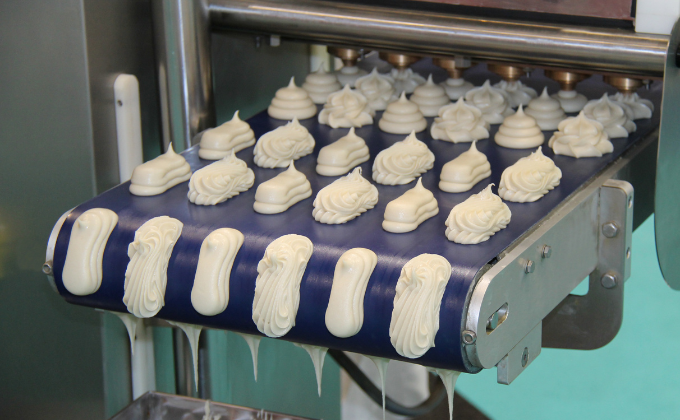
Food grade silicone sheet and moulded components are used across processing lines for product contact surfaces — conveyor belts, transfer pads, portion guides, and scraper blades. In applications where a conveyor surface contacts the food product directly, the combination of non-stick surface properties, high-temperature resistance, and food contact certification makes silicone the default choice. Silicone sheet in 1-10mm thickness, cut to specific dimensions, provides a cost-effective solution for smaller contact surface components.
For healthcare and pharmaceutical manufacturing lines with similar hygienic requirements, the same material grades apply. Delta’s healthcare and pharmaceutical sector capabilities cover the crossover between food-grade and pharmaceutical-grade silicone specifications.

Silicone vs EPDM vs Nitrile: Which Is Best for Food Contact?
| Property | Food Grade Silicone | Food Grade EPDM | Nitrile (NBR) |
|---|---|---|---|
| Temperature range | -60°C to +230°C | -40°C to +120°C | -30°C to +100°C |
| FDA 21CFR177.2600 | Available (when properly formulated) | Available (when properly formulated) | Not recommended for food contact |
| EC 1935/2004 DoC | Available | Available (grade-dependent) | Not standard |
| Autoclave compatible (121°C) | Yes | At limit — 120°C max | No |
| CIP/SIP compatible | Yes | Yes (CIP); limited SIP | No |
| Oil/fat resistance | Low-moderate | Poor | Excellent (not food safe) |
| Steam resistance | Excellent | Good (below 130°C) | Poor |
| Flavour/odour transfer | None | Minimal | Risk of extractables |
| Translucent grade available | Yes | No (typically black) | No (typically black/brown) |
| Relative cost | Higher | Lower | Lowest |
Nitrile’s excellent oil resistance, which makes it the dominant choice in hydraulic and fuel handling applications, comes from the acrylonitrile content of the compound. That same chemistry is why nitrile is not suitable for food contact — potential extractables and the absence of food-grade formulations in standard grades. Any engineer who has used nitrile seals in industrial machinery should not transfer that specification to food contact equipment.
EPDM food grade grades are a legitimate alternative to silicone for lower-temperature food processing applications where the cost differential matters. In ambient-temperature liquid handling, conveyor systems, and applications where sterilisation cycles stay at or below 115°C, food grade EPDM performs well and costs less. The ceiling is autoclave sterilisation — 121°C is at the top of EPDM’s reliable range, and repeated autoclave cycling will eventually cause compression set in EPDM seals that silicone resists.
How to Specify Food Grade Silicone: What to Ask Your Supplier
Procurement for food contact applications requires documentation, not just a product data sheet. Before placing an order, confirm the following with your supplier:
Regulatory compliance documents required: – Declaration of Compliance referencing EC 1935/2004 (UK/EU food processing) – Certificate of conformity to FDA 21CFR177.2600 (if FDA compliance needed) – Migration test reports or confirmation that migration testing has been conducted – 3-A Standard 18-03 compliance documentation (dairy applications) – WRAS approval documentation (potable water contact applications — separate requirement)
Technical specification questions: – Cure system: platinum-cured silicone is generally preferred over peroxide-cured in food applications due to lower migration risk from curing residues. Confirm which cure system is used. – Shore A hardness: typical food grade silicone is available from approximately 30 to 80 Shore A. Sealing applications typically use 40-60 Shore A; higher hardness for structural components. Confirm the hardness matches your compression requirements. – Colour: white or translucent for general food contact; confirm pigments used in coloured grades are food contact approved. – Temperature certification: confirm the continuous service rating, not just the maximum short-term temperature.
Which Material Should You Specify?
The decision between food grade silicone, food grade EPDM, and other alternatives comes down to four variables: operating temperature, sterilisation method, regulatory requirement, and product type. Use this framework:
Specify food grade silicone when: – Operating temperature exceeds 120°C, or autoclave sterilisation is required – SIP (steam-in-place) sterilisation is used – Pharmaceutical-grade documentation is required alongside food contact certification – Visual inspection of the seal is required (translucent grade) – The application is in dairy, beverage, or pharmaceutical liquid transfer where flavour neutrality is critical – The component contacts fatty or oily food products at elevated temperatures
Specify food grade EPDM when: – Operating temperatures stay below 110°C in continuous service – CIP cleaning is used but SIP is not required – Cost is a significant constraint and the application does not require autoclave sterilisation – The application is in ambient-temperature water handling or beverage conveyance
Do not specify nitrile for any food contact application. Standard nitrile grades are not formulated for food contact, and the extractable compounds present in nitrile compounds are not compliant with 21CFR177.2600 or EC 1935/2004. Nitrile seals that have been used in repurposed industrial equipment entering a food processing line must be replaced before any food contact use.
For applications with dual requirements — for example, a processing line that also handles potable water supply connections — specify the regulatory requirements for each component independently. Food contact compliance (EC 1935/2004) and potable water compliance (WRAS) are separate frameworks covering separate risks, and a single approval does not substitute for the other.
The Custom Gasket Builder at gaskets-direct.co.uk allows engineers to specify food grade silicone gaskets to their exact dimensions, including material grade, hardness, and thickness, with regulatory documentation available on request.
Frequently Asked Questions
Is all silicone rubber food safe? No. Silicone rubber is only food safe when formulated specifically for food contact use with approved ingredients under FDA 21CFR177.2600 and/or EC 1935/2004. Standard industrial silicone may contain curing residues, fillers, or pigments that are not permitted for food contact. Always request a Declaration of Compliance or certificate of conformity from your supplier before using any silicone component in a food contact application.
What is the difference between FDA 21CFR177.2600 and EC 1935/2004 for silicone rubber? 21CFR177.2600 is the US FDA standard specifying the permitted ingredients in rubber articles for repeated food contact. EC 1935/2004 is the EU/UK framework regulation setting general safety and migration requirements for all food contact materials. They are separate frameworks and compliance with one does not guarantee compliance with the other, although silicone formulated to both standards is widely available. UK food processors should request declarations of compliance covering EC 1935/2004 as a minimum.
Can food grade silicone be autoclaved? Yes. Food grade silicone withstands repeated autoclave sterilisation at standard cycles of 121°C/15 psi/15 minutes and at higher-temperature pharmaceutical cycles of 134°C/3 minutes. No other food-safe elastomer matches this autoclavability — food grade EPDM is at its temperature limit at 121°C, and nitrile is not suitable for steam sterilisation at all.
What Shore A hardness should I specify for food grade silicone gaskets? For compressed gasket applications in hygienic pipework and process equipment, 40-60 Shore A is the standard range. Softer grades (30-40 Shore A) are used where very low compression forces are needed or where the mating surfaces are irregular. Harder grades (65-80 Shore A) suit structural components and applications where creep resistance under sustained load is more important than sealing compliance.
Is food grade silicone suitable for CIP cleaning with caustic and acid? Yes, under standard food industry CIP conditions. Food grade silicone is compatible with sodium hydroxide (caustic soda) at 1-3% concentration and nitric or phosphoric acid at 0.5-1.5% concentration at temperatures up to 85°C — the parameters used in the vast majority of CIP circuits in dairy, beverage, and food processing. For non-standard cleaning chemicals, or concentrations above these ranges, confirm compatibility with the silicone compound supplier before specifying.
Does food grade silicone approval for food contact also cover potable water contact? No. Food contact certification under EC 1935/2004 and FDA 21CFR177.2600 covers food and beverage contact, not potable water contact. Potable water applications require WRAS (Water Regulations Advisory Scheme) approval in the UK. These are separate regulatory frameworks and separate testing regimes. Specify WRAS-approved silicone for any component in contact with drinking water supply systems.
Food grade silicone rubber sets the standard for food contact elastomers because its properties map directly onto the requirements of modern food processing: extreme temperature range, CIP/SIP compatibility, no extractables, and regulatory coverage under both FDA 21CFR177.2600 and EC 1935/2004. The material costs more than EPDM, but in any application involving autoclave sterilisation, high-temperature processing, or pharmaceutical-grade documentation requirements, it is the only elastomer that genuinely meets the brief.
Delta Rubber supplies food grade silicone sheet, tubing, and custom gaskets with full regulatory documentation. View the silicone rubber product range or explore Delta’s capabilities for the food production sector to discuss your specific application.