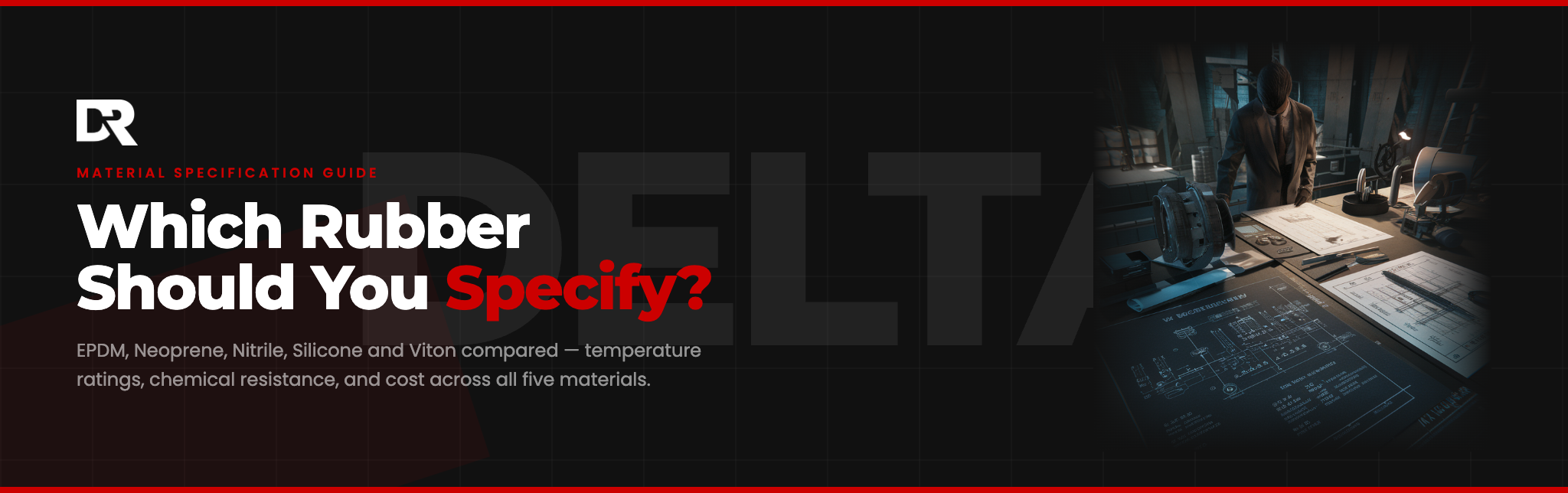
EPDM vs Neoprene vs Nitrile vs Silicone vs Viton: Which Rubber Is Right for Your Application?
Choosing the wrong rubber compound for a seal, gasket, or sheet application does not just risk premature failure — it can mean unplanned downtime, chemical contamination, or a safety incident. The five most widely specified industrial rubber materials in the UK are EPDM, Neoprene (CR), Nitrile (NBR), Silicone, and Viton (FKM). Each has a distinct combination of temperature range, chemical resistance, mechanical properties, and cost. EPDM excels in outdoor and water-contact applications but has zero oil resistance. Nitrile handles oils and fuels better than any general-purpose compound. Silicone operates from -60°C to +230°C, making it the default for extreme heat. Viton offers the broadest chemical resistance of any elastomer in this group, at roughly eight times the cost of EPDM. Neoprene sits in the middle on every axis — a moderate performer where no single property dominates.
This guide gives you a direct, property-by-property comparison of all five materials, plus a five-question decision framework to identify the right choice for your specific application.
Why Rubber Material Selection Matters
Specifying a rubber compound is not interchangeable with selecting a plastic or metal grade. Elastomers are formulated for specific environments, and a misspecification that works perfectly for six months can fail catastrophically in the seventh when exposure conditions change. Procurement teams and design engineers encounter this problem most often when a seal originally specified for water service is later exposed to a hydraulic fluid, or when an outdoor application calls for a general-purpose compound that has no UV resistance.
The five materials covered here represent the vast majority of industrial rubber demand in the UK market. Understanding where each one excels — and where it fails — is the core of sound materials engineering. The properties that drive selection are: operating temperature range, resistance to oils and fuels, resistance to ozone and UV (relevant for any outdoor or unenclosed application), chemical resistance to solvents and acids, mechanical strength, and cost relative to application life.
Getting this decision right at specification stage is always cheaper than a field failure, a product recall, or a non-conformance under ISO 9001 quality management systems.
The 5 Main Industrial Rubber Materials at a Glance
The table below summarises the key properties and relative cost index for each material. Cost index is normalised to EPDM as 1.
| Material | Temp Range | Oil Resistance | Ozone/UV Resistance | Relative Cost | Best For |
|---|---|---|---|---|---|
| EPDM | -40°C to +120°C | None | Excellent | 1× | Outdoor seals, water, steam, roofing |
| Neoprene (CR) | -40°C to +100°C | Moderate | Good | 1.5× | General-purpose, marine, moderate oil |
| Nitrile (NBR) | -40°C to +120°C | Excellent | Poor | 1.5× | Hydraulic seals, fuel systems, oil gaskets |
| Silicone | -60°C to +230°C | Poor | Good | 3× | High-temp food/pharma, static seals |
| Viton (FKM) | -20°C to +200°C | Excellent | Excellent | 8× | Aggressive chemicals, fuels, harsh environments |
EPDM: Best For Outdoor, Water, and Steam Applications
EPDM rubber (Ethylene Propylene Diene Monomer) is the most widely used synthetic rubber for outdoor and water-contact sealing in the UK. Its backbone structure — a fully saturated main chain with no double bonds — gives it outstanding resistance to ozone, UV radiation, and atmospheric weathering. Where a natural rubber seal would crack within months of outdoor exposure, EPDM holds its properties for years.
EPDM Best For
EPDM is the standard material of choice for:
- Roofing membranes and building construction seals, where 20+ year service life under UV exposure is required
- Drinking water pipework seals compliant with WRAS (Water Regulations Advisory Scheme) approval
- Automotive door and window seals exposed to rain, temperature cycling, and UV
- Steam hoses rated to +120°C in industrial process environments
- HVAC ductwork gaskets and weatherstripping
EPDM’s water and steam resistance is exceptional. At temperatures up to +120°C in hot water or steam service, it significantly outlasts Neoprene or Nitrile under the same conditions. Its low-temperature flexibility down to -40°C makes it suitable for cold-climate outdoor installations without the brittleness that affects some alternatives.
EPDM Not Suitable For
EPDM has no oil or fuel resistance whatsoever. Contact with mineral oil, hydraulic fluid, petrol, diesel, or any petroleum-based product causes rapid swelling, softening, and mechanical failure. An EPDM seal in an oil-lubricated fitting will fail — there is no marginal performance zone here. Similarly, EPDM is not suitable for concentrated acids, aromatic solvents, or halogenated solvents.
For any application involving oil, fuel, or hydrocarbon exposure, the correct choice is Nitrile or Viton, not EPDM.
Neoprene: Best For General-Purpose and Marine Applications
Neoprene rubber (Polychloroprene, CR) occupies the middle ground in the industrial rubber market. It offers a broader capability profile than EPDM or Nitrile individually, which makes it useful where a single dominant resistance isn’t required but no single weakness can be tolerated.
Neoprene Best For
Neoprene’s combination of moderate oil resistance, good ozone resistance, and reasonable flame retardancy makes it well-suited for:
- Marine applications where both weather resistance and moderate oil splash exposure are present simultaneously
- Electrical cable jacketing where flame resistance is a safety requirement
- Conveyor belts in general industrial environments
- Automotive engine mounts and vibration dampers
- Refrigerant seals — Neoprene has good resistance to R-22 and similar refrigerants
- General-purpose sheet gaskets where no aggressive chemicals are present
Neoprene’s ozone resistance is good (though not quite at EPDM’s level), and its flame resistance is better than most elastomers in this group. Shore hardness is adjustable across a practical range, and its mechanical strength is above average, giving it reliable performance in dynamic sealing applications.
Neoprene Not Suitable For
Neoprene should not be specified for applications with sustained exposure to aromatic hydrocarbons, chlorinated solvents, or strong oxidising acids. Its oil resistance, while moderate, is nowhere near Nitrile’s — do not specify Neoprene as an oil seal in a hydraulic or fuel system. For those applications, Nitrile or Viton is the correct choice. Neoprene also falls short at temperatures above +100°C, where Silicone or Viton are needed.
Nitrile (NBR): Best For Oil, Fuel, and Hydraulic Sealing
Nitrile rubber (Acrylonitrile Butadiene Rubber, NBR) is the industry standard for oil and fuel sealing. Its acrylonitrile content — typically 28% to 45% — determines the balance between oil resistance and low-temperature flexibility. High ACN grades (40-45%) offer maximum oil resistance but reduce flexibility at low temperatures. Medium ACN grades (33-36%) provide the best overall balance for most hydraulic and fuel applications.
Nitrile Best For
Nitrile is the default specification for:
- Hydraulic cylinder seals and O-rings in mineral oil systems
- Fuel system seals and diaphragms in automotive and industrial machinery
- Pneumatic seals exposed to oil-lubricated air
- Oil-resistant gaskets in pumps, compressors, and gearboxes
- Printing industry rollers where ink solvents are present
- Food-contact applications where NBR compounds are formulated to FDA 21 CFR 177.2600 compliance (food-grade NBR grades)
Nitrile at 40% ACN shows volumetric swell of under 5% in IRM 903 reference oil at 100°C — a level of oil resistance that Neoprene cannot match and EPDM cannot approach at all. Its temperature range of -40°C to +120°C covers the majority of hydraulic and fuel system operating conditions.
Nitrile Not Suitable For
Nitrile’s Achilles heel is ozone resistance. Nitrile is highly susceptible to ozone cracking, which means outdoor or unenclosed storage and installation significantly reduces service life. Any Nitrile seal stored in direct sunlight or in an environment with high ozone concentration (near electrical switchgear, arc welders, or motor rooms) is at risk. For outdoor fuel systems, specify Viton instead of Nitrile.
Nitrile also has poor resistance to aromatic fuels, ketones, and brake fluids. An application involving Skydrol hydraulic fluid (phosphate ester-based) or any ester-based lubricant requires Viton, not Nitrile.
Silicone: Best For High-Temperature and Food/Pharmaceutical Applications
Silicone rubber (VMQ/PVMQ) has the broadest operating temperature range of any common elastomer. Silicone’s inorganic Si-O-Si backbone is fundamentally different from the carbon-based chain in EPDM, Nitrile, and Neoprene — and that difference is why silicone retains flexibility and elasticity from -60°C to +230°C, a range no organic rubber can match.
Silicone Best For
Silicone is specified when temperature is the controlling factor, or when food and pharmaceutical compliance is mandatory:
- Oven seals, baking equipment gaskets, and food processing line seals where FDA 21 CFR 177.2600 compliance is required
- Pharmaceutical manufacturing where USP Class VI biocompatibility is needed
- Automotive turbocharger hoses and charge-air cooler connections where inlet temperatures exceed +150°C
- Electronics enclosure seals where wide temperature cycling from -60°C to +200°C occurs
- Medical device components requiring steam autoclave sterilisation at +134°C
- Static seals in high-temperature chemical processing where dynamic compression is not required
Silicone’s electrical insulation properties are excellent (dielectric strength up to 20 kV/mm), which adds value in electrical applications where the seal must also act as an insulator.
Silicone Not Suitable For
Silicone has significantly lower tensile strength and tear resistance than Nitrile, EPDM, or Neoprene — typically 5-10 MPa tensile strength versus 15-25 MPa for Nitrile. Silicone is not suitable for dynamic sealing applications with high mechanical load, cut resistance requirements, or abrasive wear. It also performs poorly in contact with steam above +130°C (where EPDM or Viton are preferred), concentrated acids, and aromatic solvents. The cost premium — approximately three times that of EPDM — makes it uneconomical for general-purpose applications where temperature extremes are not present.
Viton (FKM): Best For Aggressive Chemicals and High-Temperature Fuels
Viton rubber (Fluoroelastomer, FKM) is the premium engineering elastomer. Developed originally for aerospace applications, Viton’s fluorine-rich polymer structure gives it chemical resistance that no other compound in this group approaches. Where Nitrile resists standard mineral oils and Silicone handles temperature extremes, Viton resists both simultaneously — while also holding up to fuels, solvents, acids, and halogenated compounds that would rapidly degrade every other material listed here.
Viton Best For
Viton is specified when failure consequences are high, chemical environments are aggressive, or both:
- Aerospace and defence fuel system seals conforming to BS/AS specifications
- Chemical processing seals exposed to concentrated sulphuric acid, hydrochloric acid, and aromatic solvents
- Automotive seals in direct contact with modern biofuel blends (E10, E15) and diesel particulate filter fluids (AdBlue/DEF)
- High-temperature oil system seals where operating temperatures exceed +150°C and Nitrile is no longer viable
- Pharmaceutical and semiconductor processing equipment where contamination from elastomer leachates cannot be tolerated
- Offshore oil and gas applications requiring sour service (H2S) resistance
Viton retains mechanical properties at +200°C continuous service and can handle short-duration excursions to +230°C. Its resistance to aromatic fuels — including 100% toluene and xylene — is near-total, which is why it replaced Nitrile in modern fuel injection systems.
Viton Not Suitable For
At approximately eight times the material cost of EPDM, Viton is overspecified for general-purpose sealing. It also has poor resistance to low-molecular-weight esters, ketones (such as acetone and MEK), and amines. Viton is not suitable for steam sealing at temperatures above +200°C — PTFE is the correct material for those conditions. Its low-temperature flexibility limit of -20°C (for standard grades) means it is not suitable for cold-climate outdoor installations without selecting specialist low-temperature FKM grades (GLT or GFLT).
Chemical Resistance Comparison Table
The table below gives a direct, application-ready comparison across the six most common exposure categories. Ratings: E = Excellent, G = Good, M = Moderate, P = Poor, N = None/Not Suitable.
| Exposure | EPDM | Neoprene | Nitrile (NBR) | Silicone | Viton (FKM) |
|---|---|---|---|---|---|
| Mineral oils & hydraulic fluids | N | M | E | P | E |
| Petrol/diesel fuels | N | P | G | P | E |
| Aromatic fuels (toluene, xylene) | N | P | P | P | E |
| Water & steam (to +120°C) | E | G | G | G | G |
| Ozone & UV weathering | E | G | P | G | E |
| Concentrated acids | P | M | P | P | E |
| Dilute acids | G | G | G | G | E |
| Alkalis (caustic soda etc.) | G | G | G | G | M |
| Ketones (acetone, MEK) | G | M | P | G | N |
| Phosphate ester fluids (Skydrol) | P | P | N | G | N |
| Chlorinated solvents | P | P | P | P | G |
| Flame resistance | P | G | P | M | G |
Temperature Range Comparison
| Material | Min Temp (°C) | Max Temp (°C) | Notes |
|---|---|---|---|
| EPDM | -40 | +120 | Excellent long-term performance in steam to +120°C; short excursions to +140°C possible |
| Neoprene (CR) | -40 | +100 | Stiffens significantly below -30°C; not for sustained high-temperature service |
| Nitrile (NBR) | -40 | +120 | Low-temperature limit varies with ACN content — high ACN grades limit to -20°C |
| Silicone | -60 | +230 | Best overall temperature range; retains flexibility at -60°C without compounding |
| Viton (FKM) | -20 | +200 | Standard grades; specialist GLT grades extend to -40°C at significant cost premium |
For applications that cycle between temperature extremes, silicone’s combination of low minimum and high maximum temperature is uniquely suited. For high-temperature chemical environments, Viton’s +200°C ceiling with broad chemical resistance is unmatched by any elastomer in this group.
Which Rubber Should You Choose? A 5-Question Decision Framework
Most rubber material selection decisions can be resolved by working through five questions in sequence. Answer each question in order — the first answer that produces a clear recommendation is your material.
Question 1: Is oil, fuel, or any hydrocarbon present in the application?
If yes: Rule out EPDM immediately. If the oil or fuel is standard mineral oil and the temperature is below +120°C, specify Nitrile (NBR). If the fuel is aromatic or a biofuel blend, or the temperature exceeds +120°C, specify Viton. If the fluid is a phosphate ester hydraulic fluid (Skydrol, Fyrquel), specify Silicone or PTFE.
Question 2: What is the maximum operating temperature?
- Below +120°C: EPDM, Neoprene, and Nitrile are all within range.
- +120°C to +180°C: Silicone or Viton only.
- Above +180°C: Viton is the correct choice for dynamic seals; PTFE for static seals.
If temperature is the only constraint (no oils, no harsh chemicals), Silicone is usually the most cost-effective choice in the +120°C to +230°C range.
Question 3: Is the application outdoors, or is ozone/UV exposure present?
Nitrile cracks in ozone-rich environments. For outdoor seals — window glazing, building expansion joints, roofing, external cable management — specify EPDM or Neoprene. If both outdoor exposure and oil contact are present (outdoor fuel tanks, marine deck fittings), specify Viton, which has excellent ozone and UV resistance.
Question 4: Is food grade or pharmaceutical compliance required?
For food contact applications, the governing standard in the UK is FDA 21 CFR 177.2600, which covers rubber articles in repeated food contact. Silicone compounds formulated to FDA 21 CFR 177.2600 are the most common choice for food processing equipment seals and hoses. Food-grade EPDM compounds are also available and WRAS-approved for potable water applications. For pharmaceutical and medical device applications where USP Class VI biocompatibility is needed, specify food-grade Silicone.
Nitrile can be formulated to FDA 21 CFR 177.2600 for static food-contact applications, but standard NBR is not food grade.
Question 5: Is cost a primary constraint, or is the application general-purpose?
If no aggressive chemicals, high temperatures, or UV exposure are present — a typical general-purpose indoor gasket, damper pad, or strip seal — EPDM or Neoprene provide long service life at the lowest cost. EPDM at cost index 1 is the default for water-contact and outdoor applications. Neoprene at 1.5× offers slightly broader all-round resistance where marginal oil splash is possible. Do not specify Silicone (3×) or Viton (8×) where the application conditions do not justify the premium.
Decision Summary Matrix
| Primary Application Condition | Recommended Material | Alternative |
|---|---|---|
| Oil/hydraulic fluid seals, standard temp | Nitrile (NBR) | Viton (high temp) |
| Fuel system seals | Nitrile (NBR) | Viton (aromatic fuels) |
| Outdoor / weathering / UV | EPDM | Neoprene |
| Water service / WRAS potable water | EPDM | Silicone |
| Steam sealing | EPDM | Viton |
| High temperature (+120–230°C) | Silicone | Viton |
| Food and pharma compliance | Silicone | Food-grade EPDM |
| Aggressive chemicals / solvents | Viton | — |
| Marine / general-purpose | Neoprene | EPDM |
| Cost-sensitive general-purpose | EPDM | Neoprene |
Common Application Examples
Understanding how these materials perform in real engineering environments removes the uncertainty from specification decisions.
Hydraulic cylinder rod seals in mobile plant and industrial machinery are specified in Nitrile (NBR) as standard, with Viton substituted where operating temperatures in the cylinder exceed +120°C or where fire-resistant hydraulic fluids are used. A hydraulic cylinder running standard ISO VG 46 mineral oil at ambient to +80°C is a straightforward Nitrile application.
Roof expansion joints and external building seals are almost exclusively EPDM. BS 6213 (the UK standard for selection of construction sealants) recognises EPDM as a primary material for building envelope applications. Service life of 20–30 years is achievable with correctly specified EPDM sheet.
Food processing conveyor seals and pump gaskets in the UK food industry are typically Silicone where FDA 21 CFR 177.2600 compliance is required, and food-grade EPDM for water-contact applications. Delta’s food production material range supports both applications — see the food production industry page for compliant compounds.
Marine deck and hull seals use Neoprene as the standard material, given its combination of UV resistance, moderate oil tolerance (bilge environments routinely contain oil contamination), and reliable performance in salt water. Viton is specified for through-hull fuel system fittings where hydrocarbon exposure is direct.
Chemical plant flange gaskets are frequently Viton when the process fluid is an aromatic solvent, mineral acid, or blended chemical stream. The custom gasket range at Delta covers Viton, Nitrile, EPDM, and Neoprene in sheet form, cut to customer specifications using CAD-based gasket cutting.
Electrical enclosure seals exposed to both UV (outdoor cabinets) and temperature cycling are EPDM or Silicone depending on the temperature range. For telecom cabinets and switchgear in outdoor substations, EPDM is standard. For equipment mounted near transformer cores or motors where radiant heat reaches +150°C, Silicone is required.
For rubber sheet in any of these materials — including cut-to-size or full rolls — Delta stocks all five compound types.
FAQ
What is the difference between EPDM and Nitrile rubber?
EPDM and Nitrile are engineered for opposite environments. EPDM excels in water, steam, UV, and ozone resistance but has zero oil resistance. Nitrile (NBR) is the industry standard for oil and fuel sealing, offering excellent resistance to mineral oils and hydraulic fluids, but it has poor ozone resistance and will crack outdoors over time. Never substitute one for the other in an application with oil or outdoor exposure.
Which rubber is best for outdoor use in the UK?
EPDM is the standard choice for outdoor rubber applications in the UK. Its fully saturated polymer backbone gives it exceptional resistance to UV radiation, ozone, and atmospheric weathering — the three conditions that degrade most other elastomers. Neoprene is a second option where some oil splash resistance is also needed, but EPDM outperforms it on pure weathering resistance and service life.
What is the most chemical-resistant rubber?
Viton (FKM) has the broadest chemical resistance of any common engineering elastomer. It resists concentrated mineral acids, aromatic fuels, halogenated solvents, and chlorinated hydrocarbons. For applications involving multiple aggressive chemicals simultaneously, Viton is the only safe choice in the five materials covered here.
Can EPDM be used with oil or hydraulic fluid?
No. EPDM has no oil resistance and should never be specified for any application involving mineral oil, hydraulic fluid, petroleum fuels, or any hydrocarbon-based fluid. Contact with these substances causes rapid swell, softening, and mechanical failure. The correct material for oil and hydraulic sealing is Nitrile (NBR) for standard temperatures, or Viton for elevated temperatures or aggressive fluid chemistries.
What rubber should I use for food grade seals and gaskets?
Silicone formulated to FDA 21 CFR 177.2600 is the most widely specified rubber for food contact seals in food processing and pharmaceutical environments. Food-grade EPDM is the standard choice for potable water contact where WRAS approval is required. Standard Nitrile, Neoprene, and Viton are not inherently food grade, though specific food-grade compound formulations are available for some applications.
What is the highest temperature rubber for seals?
Silicone rubber has the highest operating temperature range of the five common industrial elastomers, rated to +230°C continuous service. Viton (FKM) follows at +200°C continuous. For temperatures above +200°C or in applications combining high temperature with aggressive chemical exposure, PTFE (not an elastomer, but a fluoropolymer) is typically the correct material rather than any rubber compound.
Why is Viton rubber so expensive compared to EPDM?
Viton (FKM) costs approximately eight times more than EPDM per kilogram because its synthesis requires fluorine — a process-intensive chemistry — and the raw materials are significantly more expensive than the ethylene and propylene used to produce EPDM. Viton is an engineering material specified where its performance justifies the cost: high-temperature chemical sealing, fuel systems, and aerospace applications. For general-purpose sealing, EPDM or Nitrile deliver far better value.
What rubber is best for hydraulic seals?
Nitrile (NBR) is the industry-standard material for hydraulic seals in mineral oil systems. Medium ACN content (33-36%) gives the best balance of oil resistance and low-temperature flexibility for most hydraulic applications. For high-temperature hydraulic systems above +120°C, or systems using synthetic or fire-resistant hydraulic fluids, Viton is the correct upgrade.
What is the difference between Neoprene and Nitrile rubber?
Neoprene (CR) and Nitrile (NBR) are both moderate-cost general industrial rubbers, but their performance profiles are distinct. Nitrile has far superior oil and fuel resistance — it is the correct choice for any hydrocarbon-contact sealing application. Neoprene offers better ozone and UV resistance, better flame resistance, and broader chemical compatibility excluding oils. Neoprene is often used where an application has multiple moderate demands with no single dominant chemical exposure; Nitrile is chosen when oil contact is the primary concern.
How do I choose between Silicone and Viton for a high-temperature application?
If the application is above +120°C with no aggressive chemicals, Silicone is usually the more cost-effective choice (3× EPDM cost versus 8×). If the high-temperature environment also involves oils, fuels, acids, or solvents, Viton is the correct material — Silicone has poor resistance to oils and hydrocarbons. In food and pharmaceutical applications at high temperatures, food-grade Silicone is usually preferred because it is available in USP Class VI compliant formulations at a lower cost than Viton.
Selecting the right rubber is always a three-way calculation: the chemical environment, the operating temperature range, and the acceptable cost relative to application life and failure consequences. EPDM and Nitrile cover the majority of industrial sealing applications in the UK at competitive cost. Silicone and Viton are precision specifications for demanding conditions that genuinely need them. Getting these choices right at the design stage, rather than substituting on availability, is what separates reliable equipment from field failures.
Delta Rubber has supplied all five materials across manufacturing, construction, marine, food production, and aerospace applications since 2007. Browse the full range of rubber sheet and roll stock in EPDM, Nitrile, Neoprene, Silicone, and Viton, or use the custom gasket builder to specify the exact material, thickness, and cut dimensions for your application.