Silicone Hose vs Rubber Hose: Which Is Better for Your Application?
Silicone hose is the better choice for high-temperature performance applications — track days, motorsport, intercooler pipework, and sustained industrial heat above 125°C. Standard rubber hose, typically EPDM, is the correct choice for everyday road vehicles, general cooling systems, and most industrial fluid handling where temperatures stay within normal operating ranges. The critical factor most buyers overlook: silicone permeates water vapour approximately 15 times faster than EPDM rubber, which means coolant levels gradually drop in street cars fitted with silicone hoses. That single property is precisely why every OEM manufacturer fits EPDM hoses on production vehicles — not cost, not availability, but engineering logic. For track use or dedicated performance builds where the system is regularly checked and topped up, silicone’s superior temperature resistance and 10-15 year service life make it the stronger option. For a road car covering 15,000 miles a year, EPDM does everything needed at a fraction of the cost.
How Standard Rubber (EPDM) Hoses Work
Ethylene Propylene Diene Monomer — EPDM — is the dominant material in OEM cooling systems and the benchmark against which silicone is compared. The chemistry of EPDM gives it excellent resistance to water, steam, and coolant glycol mixtures, which is exactly why it became the standard material for radiator hoses, heater hoses, and overflow pipes across the automotive and industrial sectors.
A typical reinforced EPDM hose is constructed from an inner bore of EPDM compound, one or more layers of textile or synthetic fibre reinforcement (usually polyester braid or knitted fabric), and an outer EPDM cover. The reinforcement determines the pressure rating; the material determines the chemical and thermal resistance. Standard reinforced EPDM hose handles continuous service temperatures up to approximately 125°C — sufficient for virtually all production vehicle cooling systems operating at 90-100°C thermostat opening temperatures, with adequate headroom for localised peaks.
EPDM has zero compatibility with petroleum-based oils and fuels. Any application where the hose contacts engine oil, hydraulic fluid, or fuel demands a different material entirely — nitrile rubber for moderate temperatures, or Viton for elevated temperatures and aggressive chemical exposure. EPDM used in an oil circuit will swell, soften, and fail. That misapplication is common and worth stating plainly.
For coolant hose replacement on standard road vehicles, EPDM is the technically correct specification. The major OEM suppliers and manufacturers all specify it. Switching to silicone on a daily-driven road car introduces the water vapour permeation problem without delivering any meaningful performance benefit in normal operating conditions.
You can explore Delta’s full rubber hose and tubing range for EPDM options suitable for both automotive and industrial applications.
How Silicone Hoses Work
Silicone rubber (polydimethylsiloxane) is an inorganic polymer with a silicon-oxygen backbone rather than a carbon chain — which is the structural reason for its exceptional temperature stability. Where organic rubbers degrade as their carbon backbone oxidises under sustained heat, silicone retains its elasticity and mechanical properties across a far wider temperature range.
A performance silicone hose is typically constructed from multiple plies of silicone compound reinforced with polyester or aramid fibre braid between layers. High-end motorsport hoses may use three or four reinforcement plies to achieve pressure ratings above 4 bar. The multi-ply construction also gives silicone hoses their characteristic firm but pliable feel — noticeably stiffer than an equivalent EPDM hose, which some engineers find reassuring and others find less convenient during installation on tight routing paths.
Silicone handles continuous service temperatures from -60°C up to approximately 177°C, with short-duration spikes to 220°C. At the cold end, silicone remains flexible at temperatures where EPDM becomes stiff and prone to cracking — relevant for cold-climate starts or freeze-store industrial equipment. At the hot end, that 177°C continuous rating provides genuine headroom over EPDM’s 125°C ceiling. In turbocharged performance engines where intake temperatures can exceed 150°C between the turbocharger outlet and intercooler inlet, silicone is not just preferable — it is the correct engineering specification.
For a detailed overview of silicone rubber material properties, including hardness grades and chemical resistance, see the silicone rubber materials page.
Head-to-Head Comparison: Silicone vs EPDM Rubber Hose
| Property | Silicone Hose | EPDM Rubber Hose |
|---|---|---|
| Max continuous temperature | 177°C | 125°C |
| Short-duration peak temperature | 220°C | ~140°C |
| Min temperature (flexibility) | -60°C | -40°C |
| Typical pressure rating (reinforced) | 2.5–4+ bar | 2–3.5 bar |
| Water vapour permeation | ~15× higher than EPDM | Low — OEM standard |
| Flexibility / installation | Firm, slightly stiffer | Softer, easier to route |
| Typical service life (performance) | 10–15 years | 5–8 years |
| Oil / fuel resistance | Poor — not suitable | Poor — not suitable |
| Relative cost | 3–5× more than EPDM | Baseline |
| OEM cooling system use | No — permeation issue | Yes — industry standard |
| Motorsport / track use | Preferred | Adequate at lower outputs |
Both materials share the same weakness: neither tolerates petroleum-based oils or fuels. For oil circuits, specify nitrile rubber or Viton.
Temperature Resistance: Where Does Silicone Actually Win?
The 52°C difference in continuous temperature ratings between silicone (177°C) and EPDM (125°C) sounds significant on paper. In practice, it matters in a specific set of conditions — and is irrelevant in many others.
Standard road vehicle cooling systems operate with thermostat opening temperatures between 88°C and 105°C. Even under demanding motorway driving or towing conditions, the coolant temperature in a correctly functioning system rarely approaches the EPDM hose wall temperature limit of 125°C. The hose operates with substantial thermal headroom. Fitting silicone here delivers no measurable reliability benefit.
Where silicone’s temperature advantage becomes genuinely critical:
Turbocharged intake systems. Air exiting a turbocharger compressor stage can reach 150-180°C before passing through the intercooler. Hoses in this section — between the turbo outlet and intercooler inlet — must handle these temperatures continuously under hard use. EPDM is marginal or outside specification here. Silicone is the correct choice.
High-performance and race engines. Engines tuned significantly beyond OEM power outputs generate higher coolant temperatures, often running thermostats at 82°C or higher to allow more aggressive timing. Combined with sustained hard use on track where there are no traffic-stop cooling cycles, coolant temperatures can climb meaningfully closer to the EPDM ceiling. Silicone provides a genuine safety margin.
Industrial high-temperature processes. Steam lines, hot chemical transfer, and processes running above 130°C in food production, pharmaceutical manufacturing, or industrial heating circuits require a hose rated for the application. EPDM runs out of headroom; silicone handles it.
For standard industrial fluid handling within normal temperature ranges, EPDM through Delta’s rubber hose and tubing range remains the technically and economically sound choice.
Longevity: Silicone’s Hidden Weakness — Water Vapour Permeation
This is the property that most silicone hose marketing glosses over, and it is the reason every automotive OEM continues to specify EPDM for production vehicle cooling systems despite silicone’s better temperature rating and longer service life.
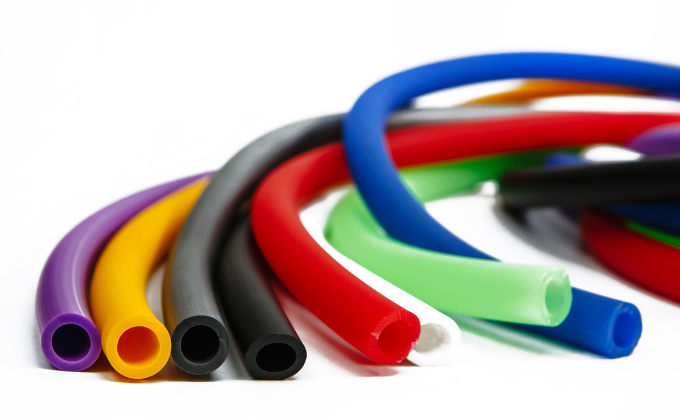
Silicone is permeable to water vapour at approximately 15 times the rate of EPDM rubber. Over time — months, not years — a cooling system fitted with silicone hoses will lose coolant concentration slowly through the hose walls. The antifreeze concentration drops. The coolant level gradually falls. On a track car inspected before every event, the system topped up and tested regularly, this is a manageable characteristic. The owner knows to check it.
On a daily-driven road car where the coolant level is checked perhaps twice a year, this permeation effect can silently degrade the cooling system. The antifreeze concentration drops below the required level, frost protection is compromised, and corrosion inhibitor performance falls. None of this shows up as an obvious fault until there is a problem.
This is not a minor caveat. It is the core engineering reason silicone is not used in OEM cooling systems despite being technically superior in temperature resistance. Understanding this property prevents an expensive and potentially damaging misspecification.
Silicone’s longevity advantage — 10-15 years versus 5-8 years for EPDM — applies under conditions where the permeation is actively managed. In race and track applications with structured maintenance schedules, silicone does genuinely outlast EPDM and justifies its cost premium over multiple seasons. In a casual road car, EPDM replaced at the recommended interval is the lower-risk and lower-total-cost specification.
Cost: Understanding the Silicone Price Premium
Silicone hose typically costs 3-5 times more than an equivalent EPDM rubber hose of the same bore, length, and pressure rating. A standard 32mm straight EPDM radiator hose might cost £8-15; the silicone equivalent from a performance supplier runs £30-60 or more. For complex moulded hoses with bends, the premium is similar.
The cost differential has several components. Silicone compounds themselves are more expensive than EPDM. Multi-ply reinforcement construction requires more manufacturing steps. And there is a market premium: silicone hoses are sold predominantly into the performance and motorsport segments where buyers accept higher prices for perceived quality.
For a race team spending a season’s budget on reliability, the silicone premium amortised across 3-5 years of racing makes sense. For a fleet manager specifying replacement hoses on a diesel generator or agricultural machinery, EPDM delivers equivalent performance for the application at a fraction of the cost.
Best Applications for EPDM Rubber Hose
EPDM is the correct specification for the following:
- Production vehicle cooling systems — all OEM-replacement radiator hoses, heater hoses, and overflow pipes on road cars, vans, and trucks operating at standard temperatures
- Agricultural and construction plant cooling — tractors, excavators, and similar equipment where operating temperatures are within the EPDM range and reliability over a service interval matters more than absolute performance
- General industrial water and coolant transfer — process water lines, cooling water circuits, heat exchanger connections operating below 120°C
- HVAC and chilled water systems — low-pressure water circulation in building services, fan coil connections, and similar applications
- Chemical transfer (water-based media) — EPDM’s resistance to aqueous solutions, mild acids, and alkalis makes it suitable for many industrial transfer applications
EPDM should not be specified for oil circuits, fuel lines, or applications above 125°C continuous. For applications with chemical resistance requirements beyond EPDM’s range, review the full EPDM material page and consult on the correct specification.

Best Applications for Silicone Hose
Silicone is the correct specification for:
- Intercooler pipework — between turbocharger and intercooler, and from intercooler to throttle body, where air temperatures exceed EPDM’s operating range
- Induction hoses on high-output engines — where sustained hard use drives intake temperatures above 130°C
- Motorsport cooling systems — where regular inspection and maintenance schedules make water vapour permeation manageable and thermal reliability is the priority
- High-temperature industrial processes — steam-traced lines, hot chemical transfer, and processing equipment running above 130°C continuous
- Cryogenic and low-temperature applications — where flexibility at temperatures below -40°C is required
- Pharmaceutical and food-grade applications — where silicone’s compliance with FDA 21 CFR 177.2600 and similar food-contact regulations is required and the process temperatures justify the premium
Silicone must not be used in contact with petroleum-based oils, fuels, or non-polar hydrocarbon solvents. Swelling and loss of mechanical properties will result. For oil return lines, crankcase ventilation to oil separator, or fuel transfer, specify nitrile or Viton.
Motorsport and Classic Car: Which Should You Choose?
For motorsport and classic car applications, the answer depends on how the vehicle is used — and the distinction matters.
Track-only and competition vehicles should use silicone. The temperature demands are real, the maintenance schedule is structured, and the coolant system is checked before every session. Water vapour permeation is not an issue when the system is regularly opened and inspected. Silicone’s service life of 10-15 years means a set of hoses installed during a rebuild will outlast most competition campaigns. The 3-5× cost premium is justified.
Classic cars used primarily on the road — weekend classics, touring event vehicles, historic rally cars used on stages but also driven to and from events — require more careful thought. If the cooling system is checked regularly and the owner is aware of the permeation characteristic, silicone performs well and the improved temperature headroom provides reassurance on hot days in traffic queues. If the car goes into storage for months without coolant checks, EPDM is the safer specification.
Fast road cars with mild modifications that see track days but also cover regular road miles fall into the same category: EPDM is technically correct unless sustained high temperatures on track create a genuine demand for silicone’s additional headroom. A stage-3 turbocharged engine making 500bhp with aggressive mapping will approach EPDM’s limits on a hot track day in a way that a mildly-mapped Stage 1 car does not.
For OEM-replacement hoses on classic cars where original specification matters, EPDM through Delta’s rubber hose and tubing range provides like-for-like performance at the correct specification.
Industrial Applications: When Each Type Makes Sense
In industrial settings, the decision framework is straightforward once the operating parameters are established. For the majority of process cooling, water transfer, and HVAC applications running below 120°C with water-based media, reinforced EPDM hose is adequate, cost-effective, and the appropriate specification. Replacing it with silicone adds cost without adding performance.
The calculus shifts in three industrial scenarios. First, where process temperatures regularly exceed 125°C — steam pipework, post-heat-exchanger connections on high-temperature processes, and heated chemical transfer lines. Second, where the process medium benefits from silicone’s compliance with food-contact or pharmaceutical-grade approvals. Third, where the operating environment includes extreme cold — outdoor installations in northern climates where overnight temperatures reach -50°C require silicone’s flexibility below the EPDM cold-flex threshold.
For industrial process applications across manufacturing, food production, and other sectors, Delta’s industry pages cover material selection guidance by sector. Complex specifications with multiple requirements — temperature, chemical resistance, regulatory compliance — benefit from direct consultation.
Which Should You Choose? A 5-Question Decision Framework
Work through these questions in order. The first question that gives a definitive answer is your specification.
1. Does the application involve petroleum-based oil, fuel, or hydrocarbon solvents? If yes: specify nitrile or Viton regardless of temperature. Neither silicone nor EPDM is suitable. Stop here.
2. Will the hose experience continuous temperatures above 125°C? If yes: specify silicone. EPDM is outside its operating range. Stop here.
3. Is this a competition or track-only vehicle with structured pre-event maintenance? If yes: silicone is preferred for its temperature headroom and service life. The permeation issue is managed by your maintenance schedule.
4. Is this a daily-driven or irregularly maintained road vehicle or cooling circuit? If yes: specify EPDM. The water vapour permeation characteristic of silicone creates a slow-developing risk that EPDM does not. EPDM at the standard replacement interval is the lower-risk and lower-cost choice.
5. Is cost a primary constraint with standard operating conditions? If yes: EPDM delivers full performance for standard-temperature water and coolant applications at 3-5× lower cost than silicone.
If none of the above gives a clear answer, the application likely sits in the zone where both materials work and the decision comes down to budget and preferred service life. Silicone’s longer service life can amortise the cost premium in applications where replacement is expensive or disruptive.
Frequently Asked Questions
Can I fit silicone hoses to my daily-driven road car? You can, but the engineering case for doing so is weak. Silicone permeates water vapour approximately 15 times faster than EPDM, which causes coolant levels to gradually drop in everyday use. OEM manufacturers use EPDM for exactly this reason. Unless your road car is running power outputs or modifications that genuinely push coolant temperatures towards EPDM’s limits, EPDM is the correct specification and will not compromise performance.
How long do silicone hoses last compared to rubber hoses? Silicone hoses in performance applications typically last 10-15 years before needing replacement. Standard EPDM OEM-type hoses are generally recommended for replacement at 5-8 years or whenever cracking, hardening, or internal delamination is visible. Silicone’s longer service life can offset its higher upfront cost in demanding applications where replacement requires significant labour.
Why do OEM manufacturers use rubber instead of silicone? The primary reason is water vapour permeation. Silicone allows water vapour to migrate through the hose wall at approximately 15 times the rate of EPDM, which means coolant concentration slowly degrades in a sealed system that is not regularly opened and inspected. EPDM’s resistance to water permeation keeps the cooling system stable between service intervals. Cost is a secondary factor, but the engineering reason comes first.
Is silicone hose better for classic cars? For classic cars used regularly on track or in competition with proper maintenance schedules, silicone provides a worthwhile temperature margin and longer service life. For classic road cars driven seasonally and stored for months without coolant system checks, EPDM is safer — the permeation characteristic won’t silently degrade the system. A classic car driven hard on summer tours and properly maintained either way is a candidate for silicone; one that sits in a garage between summer weekends is better served by EPDM.
Can silicone hose be used for oil lines? No. Silicone has poor resistance to petroleum-based oils and will swell and lose mechanical integrity in oil-contact applications. For engine oil lines, oil cooler hoses, and hydraulic connections, specify nitrile rubber for standard operating temperatures or Viton for high-temperature or chemically aggressive environments.
What is the temperature rating for EPDM radiator hose? Standard reinforced EPDM radiator and heater hose is rated for continuous service at approximately 125°C, with short-duration peaks to around 140°C. The majority of production vehicle cooling systems operate with thermostat temperatures between 88°C and 105°C, leaving a meaningful margin within EPDM’s rating for normal operating conditions.
The choice between silicone and EPDM hose is not about which is superior in absolute terms — it is about matching the material’s properties to the actual operating conditions. For high-temperature performance and motorsport use, silicone is the correct engineering specification. For road vehicles, standard cooling circuits, and most industrial fluid handling within normal temperature ranges, EPDM delivers everything required at a fraction of the cost, without the water vapour permeation characteristics that make silicone a liability in poorly-maintained systems.
Browse Delta’s rubber hose and tubing range for EPDM options, or visit the silicone rubber page for performance and high-temperature applications.