Rubber Seals and Gaskets for Electric Vehicles: Which Materials Do Engineers Specify?
Rubber seals and gaskets for electric vehicles must meet a substantially more demanding specification than those used in conventional ICE powertrains. EV battery packs, power electronics, and motor assemblies operate at elevated temperatures, carry high-voltage cabling, and are exposed to glycol-based coolants, thermal management fluids, and the risk of thermal runaway events — conditions that can destroy seals specified for a standard automotive environment. The four elastomers that dominate EV sealing applications in the UK and European market are silicone, Viton (FKM), EPDM, and flame-retardant or conductive specialist grades. Each occupies a distinct role: silicone handles extreme thermal cycling, Viton resists the coolant chemistries used in battery thermal management systems, EPDM protects exterior cable entries and weathersealing applications, and specialist grades address EMI shielding and fire containment. Getting the material specification wrong in an EV context does not simply mean early seal failure — it can mean battery pack flooding, thermal runaway propagation, or HV cable arc events.
Why Sealing Is Critical in EV Battery Systems
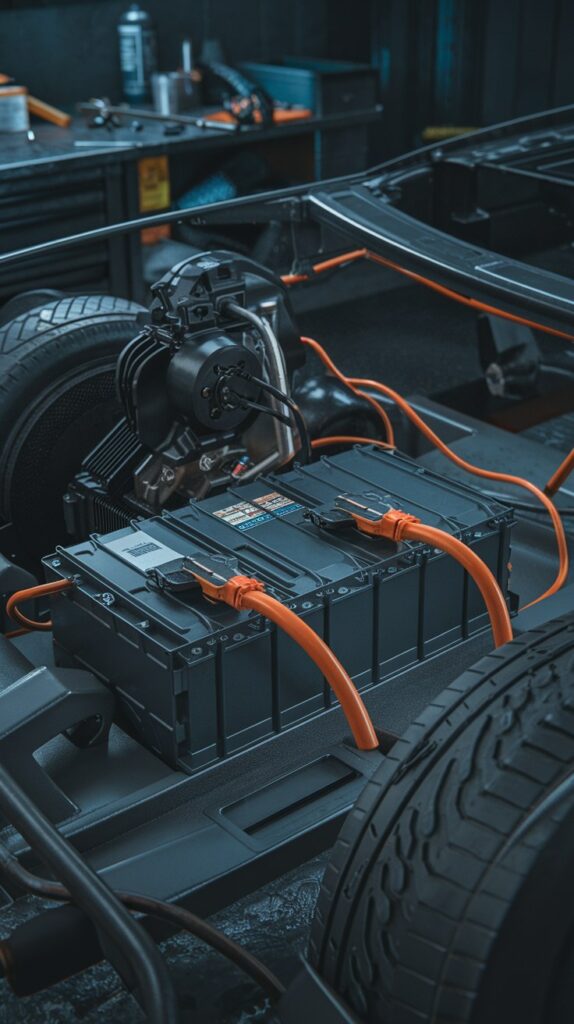
The battery pack is the most safety-critical assembly in any electric vehicle, and its sealing requirements are unlike anything in conventional automotive design. A typical lithium-ion battery pack combines high energy density, high operating temperatures, and significant electrolyte chemistry — three factors that place exceptional demands on every gasket and seal in the enclosure.
Battery management systems (BMS) generate heat across the full operating cycle. Cells in fast-charge conditions can push enclosure temperatures beyond 80°C on a sustained basis, with localised hotspots in high-current bus bar regions running significantly higher. Coolant circuits that regulate cell temperature use glycol-water mixtures or more aggressive dielectric fluids, both of which attack elastomers that lack appropriate chemical resistance.
Beyond temperature and chemistry, EV battery enclosures must meet IP67 ingress protection as a minimum, and increasingly IP69K for commercial and off-highway EV platforms. IP67 requires the enclosure to withstand immersion to 1 metre depth for 30 minutes without water ingress. IP69K — the standard more commonly demanded by fleet operators and agricultural EV platforms — requires resistance to high-pressure, high-temperature wash-down at 80 bar and 80°C from a distance of 100-150 mm. Standard automotive foam seals and general-purpose EPDM gaskets do not reliably meet IP69K without specific material and compression design.
What Are the Key Sealing Challenges in EV Applications?
Thermal Runaway Containment
Thermal runaway is the condition where a lithium-ion cell’s exothermic reactions become self-sustaining. It typically initiates at cell temperatures above 150°C and can produce rapid venting of flammable gases, with peak event temperatures exceeding 500°C in severe cases. Seals within the battery enclosure must not simply survive normal operating temperatures — they must contain or retard the spread of gases and heat during a thermal event long enough for protective systems to function.
UL 94 V-0 rated flame-retardant silicone is the standard specification for seals used in proximity to cell arrays. V-0 classification requires that a material self-extinguishes within 10 seconds of flame removal, with no dripping of flaming particles. Standard silicone is not inherently V-0 — the flame-retardant grade is a distinct compound and must be explicitly specified when ordering.
IP67 and IP69K Ingress Protection
Achieving a consistent IP67 or IP69K seal depends on three variables: material selection, compression set performance, and groove design. A gasket that provides an adequate seal on day one may allow ingress after 500 thermal cycles if the material’s compression set is too high — that is, if the rubber takes a permanent set rather than recovering its sealing force.
Silicone achieves compression set values of under 25% after 70 hours at 200°C (per ISO 815), making it the preferred material where thermal cycling is intensive. EPDM performs well in static IP67 applications where temperatures remain below 120°C. Neither standard nitrile nor SBR should be specified for EV battery enclosure sealing — their compression set performance and chemical resistance are inadequate for the application.
Vibration Fatigue
Electric motors generate vibration across a different frequency spectrum to internal combustion engines — particularly at higher frequencies from motor switching and inverter operation. Battery pack gaskets and enclosure seals must absorb continuous micro-vibration without fretting, cracking, or losing sealing force over time.
Silicone and Viton both exhibit good dynamic fatigue resistance when compounded correctly. Shore A hardness for EV enclosure gaskets typically falls in the 40-70 range — softer compounds in the 40-50 Shore A range provide better vibration damping and conform more readily to surface imperfections; harder compounds in the 60-70 Shore A range are preferred where a positive compression stop is required to prevent over-compression.
Best Rubber Materials for EV Applications
Silicone Rubber: The Primary EV Seal Material
Silicone is the dominant gasket and seal material across EV battery pack and power electronics applications. Its continuous service temperature range of -80°C to +250°C covers every thermal condition an EV enclosure encounters, from cold-soak at -40°C in winter storage through to high-current fast-charge conditions. Silicone retains its elasticity at both extremes — critical for maintaining sealing force across the thermal cycle.
Key properties relevant to EV applications:
- Temperature range: -80°C to +250°C continuous service
- Compression set: less than 25% after 70h at 200°C (ISO 815)
- UL 94 V-0 flame-retardant grades available for cell proximity applications
- Conductive silicone grades provide EMI/RFI shielding up to 120 dB in the GHz range
- Low gas permeability grades available for battery vent path management
Silicone’s primary limitation is poor resistance to petroleum-based oils and fuels. In EV applications this is rarely a concern, but where hybrid powertrains retain an engine oil circuit, silicone seals should not be used in engine compartment locations that see oil splash.
Delta’s silicone rubber sheet and extrusion range covers both standard and flame-retardant grades, with custom extrusions available for enclosure lip seals and door gaskets.
Viton (FKM): Coolant System and Thermal Fluid Sealing
Viton — the FKM (fluoroelastomer) family — is specified wherever battery thermal management circuits use glycol-water coolants, dielectric immersion fluids, or refrigerant-based cooling systems. Standard EPDM, while excellent in water applications, swells significantly in contact with glycol/water mixtures at elevated temperature. Viton does not.
Key properties relevant to EV thermal management:
- Temperature range: -20°C to +200°C continuous service
- Resistant to glycol/water coolants at all mixture ratios up to 120°C
- Resistant to dielectric thermal fluids (3M Novec, Galden PFPE series)
- Resistant to refrigerants including R134a and R1234yf (used in heat pump-equipped EVs)
- Chemical resistance extends to battery electrolyte vapours in vented applications
FKM’s limitation is cost — it carries a significant premium over silicone and EPDM. The engineering case is straightforward: specify Viton for any seal in direct contact with coolant chemistry, and silicone or EPDM elsewhere. Mixing up these applications is one of the most common misspecification errors in EV thermal management assembly.
Delta’s Viton rubber range includes sheet material and can produce custom gaskets via the gaskets-direct.co.uk platform for cut-to-size FKM components.
EPDM: Weathersealing, Cable Entries, and Exterior Grommets
EPDM is the correct specification for all exterior weathersealing applications on an EV body — door seals, boot seals, bonnet seals, and external cable entry grommets. Its operating range of -40°C to +120°C and excellent resistance to UV, ozone, and weathering make it the standard choice for vehicle body sealing applications.
In EV-specific applications, EPDM is the preferred material for:
- Cable entry grommets at body panel penetrations
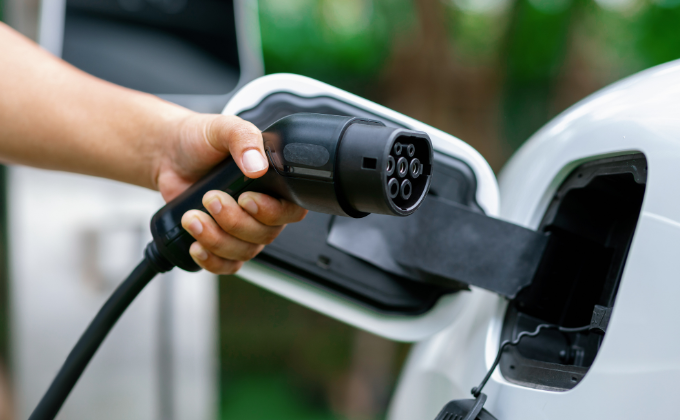
- Charging port surround seals
- External battery tray weatherstrip sealing
- Underfloor battery cover edge gaskets not directly exposed to coolant
EPDM must not be used in contact with petroleum oils, fuels, or glycol-based coolants at elevated temperatures. Specifying EPDM for a coolant system seal is a misapplication that results in swell, loss of compression set, and eventual seal failure.
Flame-Retardant and Conductive Grades
Two specialist rubber grades deserve specific attention in EV design:
Flame-retardant silicone (UL 94 V-0): Required for any seal or grommet in proximity to lithium cell arrays. Standard silicone will burn if ignited — V-0 grade will not sustain combustion. The distinction matters enormously in type approval and insurance contexts. Specify the grade explicitly on drawings — “silicone” alone does not guarantee V-0 compliance.
Conductive silicone: Battery management systems, inverters, and DC-DC converters are sensitive to electromagnetic interference. Conductive silicone gaskets loaded with carbon black or silver-coated particles provide both environmental sealing and EMI/RFI shielding in a single component. These grades are characterised by surface resistivity (typically 0.01-10 ohm-cm for carbon-loaded grades) and shielding effectiveness (typically 80-120 dB across 1 MHz to 10 GHz).
Battery Pack Gaskets and Enclosure Seals
The main battery pack enclosure — typically an aluminium housing sealed with a lid — requires a gasket that can perform across thousands of thermal cycles without loss of sealing force, resist the coolant chemistry in adjacent circuits, and meet IP67 as a minimum. For most passenger EV applications, a 60 Shore A silicone flat gasket or formed-in-place silicone bead represents the benchmark specification.
For commercial EV platforms where IP69K is required, the gasket cross-section design becomes as important as the material. A simple flat gasket relies on uniform clamping force across the entire flange. A profiled gasket with a raised lip or bulb profile concentrates sealing force and is far more tolerant of flange flatness variation and non-uniform bolt loading. Custom extruded silicone profiles — available cut-to-length or as a continuous loop — are the engineering solution used by most OEM battery pack assemblers.
Cell module sub-housings within the main pack have their own sealing requirements. Inter-cell barriers and module-level seals are typically compressed silicone foam at 50-70% compression, providing both gas containment and a degree of thermal barrier between modules. Silicone foam achieves this dual role — solid silicone does not provide sufficient thermal resistance in this application.
Custom battery pack gaskets cut from sheet silicone or FKM can be ordered via the Custom Gasket Builder at gaskets-direct.co.uk — useful for low-to-medium volume programmes where custom tooling is not yet justified.
Cable Management: Grommets and Conduit Seals
High-voltage cabling in an EV carries 400V or 800V DC between the battery, inverter, motor, and charging system. Every point where this cabling penetrates a bulkhead, battery enclosure wall, or chassis panel needs a grommet or conduit seal that provides:
- IP67-rated ingress protection around the cable entry
- Mechanical protection against chafing and vibration-induced abrasion
- Flame-retardant properties in proximity to battery or high-current regions
- UV and ozone resistance for underbonnet and underbody locations
EPDM grommets handle the majority of body panel cable entries effectively. For entries through the battery pack wall or through high-temperature zones adjacent to power electronics, flame-retardant silicone grommets are the correct specification. Standard EPDM is acceptable for low-heat zones; silicone is mandatory where operating temperatures exceed 120°C or where UL 94 compliance is a design requirement.
Delta’s cable protectors range includes grommets and split convoluted conduit in EPDM and silicone grades, suitable for HV cable routing in EV platforms. For bespoke cable entry seal designs, the rubber extrusions and seals range covers custom profiles in both materials.
Motor and Drivetrain Seals
Electric motor assemblies require sealing between the motor housing and the gearbox, around shaft penetrations, and at coolant jacket interfaces. The shaft seal specification depends on the coolant type: for water-jacket cooled motors using glycol coolant, Viton lip seals and O-rings are the correct choice. For air-cooled motor housings, silicone performs well and carries cost advantages over FKM.
Motor shaft seals operate under dynamic conditions — the seal lip runs against the rotating shaft — which means compression set performance is secondary to dynamic fatigue resistance and low friction. Viton and silicone both perform well here; nitrile (NBR) should not be used where coolant contact is possible.
Gearbox oil seals on EV single-speed transmission units do contact lubricating oil, which is one application where nitrile or hydrogenated nitrile (HNBR) remains the correct specification. EPDM and silicone have essentially zero resistance to petroleum-based gear oils — a point of potential misspecification where engineers transfer experience from oil-free EV drivetrain seals to the gearbox interfaces.
Material vs Application Reference Table
| Application | Recommended Material | Key Property | Temp Range |
|---|---|---|---|
| Battery pack lid gasket | Silicone (60 Shore A) | Low compression set, IP67 | -80°C to +250°C |
| Cell module barriers | Silicone foam | Thermal barrier + gas containment | -60°C to +200°C |
| Coolant circuit seals | Viton/FKM | Glycol/thermal fluid resistance | -20°C to +200°C |
| Thermal management O-rings | Viton/FKM | Refrigerant and fluid resistance | -20°C to +200°C |
| Battery enclosure near cell array | FR Silicone (UL 94 V-0) | Flame retardancy | -60°C to +200°C |
| BMS/inverter housing gasket | Conductive silicone | EMI/RFI shielding | -80°C to +200°C |
| HV cable body grommets | EPDM | UV/ozone/weather resistance | -40°C to +120°C |
| HV cable battery entry grommets | FR Silicone | Flame retardancy + IP67 | -60°C to +200°C |
| Door seals / weatherstripping | EPDM | Ozone, UV, compression set | -40°C to +120°C |
| Motor shaft seal (coolant-cooled) | Viton/FKM | Dynamic fatigue, coolant resistance | -20°C to +200°C |
| Gearbox oil seal | NBR/HNBR | Petroleum oil resistance | -40°C to +120°C |
| Charging port surround | EPDM | Weather resistance, UV | -40°C to +120°C |
Which Material Should You Specify?
The most common specification errors in EV sealing come from treating it as a standard automotive sealing job. The decision framework is straightforward when applied systematically:
Step 1 — Identify the media contact. Does the seal contact coolant chemistry (glycol, dielectric fluid, refrigerant)? If yes: Viton/FKM is mandatory. No other standard elastomer reliably handles glycol at temperature.
Step 2 — Identify the temperature range. If the seal operates above 120°C on a continuous basis, or if it is within 200 mm of a lithium cell array, standard EPDM is eliminated. Silicone is the correct material above 120°C.
Step 3 — Assess the fire risk zone. Is the seal inside the battery pack enclosure, adjacent to cells, or in proximity to HV bus bars carrying 400V+? If yes, specify UL 94 V-0 rated flame-retardant silicone. Standard silicone is not sufficient.
Step 4 — Check EMI sensitivity. Does the sealed housing contain battery management electronics, an inverter, or a DC-DC converter? If yes, evaluate conductive silicone gaskets for combined sealing and shielding.
Step 5 — Exterior or body locations. For anything external to the battery pack — body panel cable entries, weatherstripping, charging port seals — EPDM is the correct and cost-effective choice up to 120°C without fluid contact.
The table below consolidates the decision:
| Condition | Specify |
|---|---|
| Coolant or thermal fluid contact | Viton/FKM |
| Continuous >120°C, no fluid contact | Silicone |
| Within battery cell enclosure | FR Silicone (UL 94 V-0) |
| BMS/inverter housing, EMI risk | Conductive silicone |
| Exterior body sealing, <120°C | EPDM |
| Gearbox oil contact | NBR/HNBR |
Custom vs Standard Components: When to Go Bespoke
EV battery packs are not standard products — they are engineered to specific platform geometries, and off-the-shelf gaskets rarely match the enclosure profile directly. The practical options are:
Cut-from-sheet gaskets are appropriate for flat, simple profiles. Sheet silicone or FKM can be waterjet or die-cut to exact drawings, with short lead times and no tooling cost. The Custom Gasket Builder at gaskets-direct.co.uk handles this route for one-off through to medium-volume requirements.
Extruded profiles are the correct solution for continuous lid seals, door seals, and any application needing a profiled cross-section (bulb, P-section, D-section, keyhole). Extrusions can be produced as straight lengths cut to size or as bonded loops. Lead times for custom extrusion tooling run 3-6 weeks depending on complexity. Delta’s rubber extrusions and seals range covers both standard and custom profiles in silicone, EPDM, and Viton.
Moulded components are specified where the geometry is three-dimensional — corner pieces, integrated grommet-gasket assemblies, or seal carriers with complex rib geometry. Moulded components carry tooling cost but eliminate the performance compromise of bonded or mitred extrusion joints. For safety-critical battery enclosure sealing, moulded silicone corners are preferred over bonded extruded joints wherever the enclosure geometry permits.
The cost hierarchy runs: cut sheet < extruded profile < moulded component. The performance hierarchy tends to run in the same direction — but for many EV sealing applications, a well-specified cut gasket or extruded loop performs entirely adequately and is faster to procure.
Ordering EV Rubber Components from a UK Supplier
Post-Brexit import duties apply to rubber components sourced from EU suppliers, adding 2.7-4% to component cost for standard rubber products under commodity codes in Chapter 40 of the UK Global Tariff. For volume programmes this is a material line item. UK-sourced components carry no import duty, no customs clearance delays, and no minimum order quantity penalties associated with transatlantic or Asian sourcing.
Lead time is the practical argument for UK supply on EV development programmes. Platform development cycles operate on tight timelines, and waiting 8-12 weeks for tooled components from a European or Asian manufacturer delays homologation testing. UK suppliers with in-house extrusion and cutting capability can turn around prototype quantities in days and production quantities in 2-4 weeks.
Delta Rubber supplies from Christchurch, Dorset, with same-day despatch on stocked materials and short lead times on cut-to-drawing gaskets via the Custom Gasket Builder. ISO 9001 certification means full documentation traceability — a requirement on most OEM and Tier 1 supplier qualification programmes.
Frequently Asked Questions
What rubber is used to seal EV battery packs? Silicone rubber is the primary material for EV battery pack gaskets and enclosure seals. Its continuous service range of -80°C to +250°C, low compression set, and availability in UL 94 V-0 flame-retardant and conductive grades makes it the standard choice for battery enclosure applications. Viton (FKM) is used specifically where seals contact glycol-based coolants or thermal management fluids.
Does EPDM work as an EV battery seal? EPDM is suitable for exterior weathersealing, body panel cable grommets, and charging port seals on EVs — applications without elevated temperature or coolant contact. EPDM is not suitable for battery pack enclosure seals where temperatures regularly exceed 120°C, and it must not contact glycol-based coolants, where it will swell and lose sealing performance. Inside the battery pack, silicone or FKM should be specified.
What does IP67 mean for EV seals, and how do you achieve it? IP67 requires the sealed enclosure to withstand immersion to 1 metre depth for 30 minutes without water ingress. Achieving IP67 with a rubber gasket requires the correct material (silicone or EPDM in appropriate applications), compression groove geometry designed to achieve 25-35% compression, and a material with low compression set so sealing force is maintained through thermal cycling. IP69K adds resistance to 80 bar/80°C high-pressure wash-down and requires a profiled gasket rather than a simple flat cut gasket in most designs.
Can I use standard silicone rubber in an EV battery pack near the cells? Standard silicone will burn if directly exposed to flame, though it self-extinguishes when the flame source is removed. For sealing applications inside a battery pack in proximity to lithium cell arrays — where thermal runaway is a credible risk — UL 94 V-0 rated flame-retardant silicone should be specified. This is a distinct compounded grade and must be explicitly requested; it cannot be assumed from a general silicone specification.
What rubber seals EMI from EV battery management systems? Conductive silicone gaskets are used for combined environmental sealing and EMI/RFI shielding of battery management system housings, inverters, and DC-DC converter enclosures. Carbon-loaded conductive silicone typically achieves surface resistivity of 0.01-10 ohm-cm and shielding effectiveness of 80-120 dB across 1 MHz to 10 GHz. Standard silicone provides no EMI shielding and should not be specified in this role.
Why is Viton preferred over nitrile for EV coolant system seals? Nitrile (NBR) offers reasonable resistance to petroleum oils but swells significantly in glycol-water coolants at temperatures above 60°C. EV battery thermal management systems typically run coolant at 60-80°C, and in high-performance charging scenarios higher still. Viton/FKM maintains dimensional stability and mechanical properties in contact with glycol coolants, dielectric fluids, and refrigerants across the full EV operating temperature range. Nitrile seals in EV coolant circuits will fail by swelling and compression loss within 12-24 months of service.
Specifying the right rubber material for electric vehicle sealing applications is not complex once the decision framework is clear: Viton where coolant meets rubber, silicone where heat is the primary concern, flame-retardant silicone inside the cell enclosure, and EPDM for everything exterior-facing. Getting this specification right at the design stage avoids the far greater cost of seal failure in a battery pack under vehicle warranty. Delta Rubber supplies silicone, Viton, and EPDM in sheet, extrusion, and custom gasket forms, with UK stock and short lead times. For custom battery pack gaskets, visit the Custom Gasket Builder or contact Delta directly for cut-to-drawing components and technical specification support.